


- Retrait en 2 heures
- Assortiment impressionnant
- Paiement sécurisé
- Toujours un magasin près de chez vous
- Retrait gratuit dans votre magasin Club
- 7.000.0000 titres dans notre catalogue
- Payer en toute sécurité
- Toujours un magasin près de chez vous



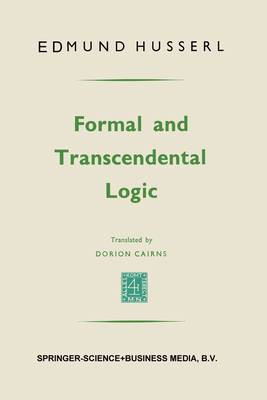
Description
Preparatory Considerations.- I / The Structures and the Sphere of Objective Formal Logic.- 1. Formal logic as apophantic analytics.- 2. Formal apophantics, formal mathematics.- 3. Theory of deductive systems and theory of multiplicities.- 4. Focusing on objects and focusing on judgments.- 5. Apophantics, as theory of sense, and truthlogic.- II / From Formal to Transcendental Logic.- 1. Psychologism and the laying of a transcendental foundation for logic.- 2. Initial questions of transcendental-logic: problems concerning fundamental concepts.- 3. The idealizing presuppositions of logic and the constitutive criticism of them.- 4. Evidential criticism of logical principles carried back to evidential criticism of experience.- 5. The subjective grounding of logic as a problem belonging to transcendental philosophy.- 6. Transcendental phenomenology and intentional psychology. The problem of transcendental psychologism.- 7. Objective logic and the phenomenology of reason.- Conclusion.- Appendix I / Syntactical Forms and Syntactical Stuffs; Core-Forms and Core-Stuffs.- § 1. The articulation of predicative judgments.- § 2. Relatedness to subject-matter in judgments.- § 3. Pure forms and pure stuffs.- § 4. Lower and higher forms. Their sense-relation to one another.- § 5. The self-contained functional unity of the self-sufficient apophansis. Division of the combination-forms of wholes into copulatives and conjunctions.- § 6. Transition to the broadest categorial sphere.- a. Universality of the combination-forms that we have distinguished.- b. The distinctions connected with articulation can be made throughout the entire categorial sphere.- c. The amplified concept of the categorial proposition contrasted with the concept of the proposition in the old apophantic analytics.- § 7. Syntactical forms, syntactical stuffs, syntaxes.- § 8. Syntagma and member. Self-sufficient judgments, and likewise judgments in the amplified sense, as syntagmas.- § 9. The "judgment-content" as the syntactical stuff of the judgment qua syntagma.- § 10. Levels of syntactical forming.- § 11. Non-syntactical forms and stuffs - exhibited within the pure syntactical stuffs.- § 12. The core-formation, with core-stuff and core-form.- § 13. Pre-eminence of the substantival category. Substantivation.- § 14. Transition to complications.- § 15. The concept of the "term" in traditional formal logic.- Appendix II / The Phenomenological Constitution of the Judgment. Originally Active Judging and Its Secondary Modifications.- § 1. Active judging, as generating objects themselves, contrasted with its secondary modifications.- § 2. From the general theory of intentionality.- a. Original consciousness and intentional modification. Static intentional explication. Explication of the "meaning" and of the meant "itself." The multiplicity of possible modes of consciousness of the Same.- b. Intentional explication of genesis. The genetic, as well as static, originality of the experiencing manners of givenness. The "primal instituting" of "apperception" with respect to every object-category.- c. The time-form of intentional genesis and the constitution of that form. Retentional modification Sedimentation in the inconspicuous substratum (unconsciousness).- § 3. Non-original manners of givenness of the judgment.- a. The retentional form as the intrinsically first form of "secondary sensuousness". The livingly changing constitution of a many-membered judgment.- b. Passive recollection and its constitutional effect for the judgment as an abiding unity.- c. The emergence of something that comes to mind apperceptionally is analogous to something coming to mind after the fashion of passive recollection.- § 4. The essential possibilities of activating passive manners of givenness.- § 5. The fundamental types of originally generative judging and of any judging whatever.- § 6. Indistinct verbal judging and its function.- § 7. The superiority of retentional and recollectiona
Spécifications
Parties prenantes
- Auteur(s) :
- Editeur:
Contenu
- Nombre de pages :
- 364
- Langue:
- Anglais
Caractéristiques
- EAN:
- 9789401746380
- Date de parution :
- 01-01-69
- Format:
- Livre broché
- Format numérique:
- Trade paperback (VS)
- Dimensions :
- 156 mm x 234 mm
- Poids :
- 508 g


Seulement chez Librairie Club
+ 302 points sur votre carte client de Librairie Club
Cadeau

Cadeau


Les avis
Nous publions uniquement les avis qui respectent les conditions requises. Consultez nos conditions pour les avis.