


- Retrait en 2 heures
- Assortiment impressionnant
- Paiement sécurisé
- Toujours un magasin près de chez vous
- Retrait en 2 heures
- Assortiment impressionnant
- Paiement sécurisé
- Toujours un magasin près de chez vous



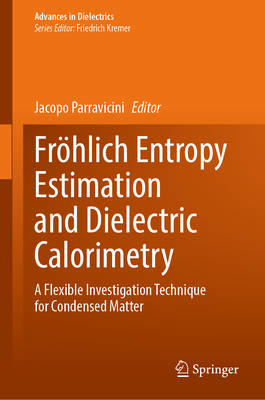
Fröhlich Entropy Estimation and Dielectric Calorimetry
129,95 €
+ 259 points
Description
This volume highlights the potential of an experimental approach, which offers a relatively simple and inexpensive alternative to conventional techniques. Its basis is the set of changes of thermodynamic variables that occur when an electric field is applied to an ideal dielectric. If these processes are experimentally measured as a function of temperature, and suitable hypotheses are met, many thermodynamic quantities can be derived from dielectric physical quantities. This enables a shift from standard dielectric thermal analysis to a more targeted dielectric calorimetry.
A central parameter affected by the electric field is the entropy variation known as Fröhlich entropy (FE), introduced by H. Fröhlich. When the imaginary part of the static dielectric function is negligible, far from resonances, FE can be calculated, under the right assumptions, from the real part of the dielectric function. Fröhlich suggested that FE reflects the state of order of the system, making it a useful figure of merit.
Assuming this interpretation, FE values offer insight into the behavior of materials, particularly with respect to temperature, phase stability, transitions, and order disorder processes. Because the underlying assumptions are weak, the method applies to many physical systems and effectively extends traditional dielectric techniques.
FE estimation has been successfully used across diverse areas of condensed matter physics, including dipolar liquids, liquid and nematic crystals, dipolar glasses, organic molecular crystals, semiconductors, metallic nanoparticles, inorganic disordered ferroelectrics, proteins, and enzymes. This breadth demonstrates its reliability and its significant, still underexplored, potential.
Spécifications
Parties prenantes
- Editeur:
Contenu
- Nombre de pages :
- 155
- Langue:
- Anglais
- Collection :
Caractéristiques
- EAN:
- 9783032214539
- Date de parution :
- 29-07-26
- Format:
- Livre relié
- Format numérique:
- Genaaid
- Dimensions :
- 155 mm x 235 mm

Seulement chez Librairie Club
+ 259 points sur votre carte client de Librairie Club
Cadeau


Les avis
Nous publions uniquement les avis qui respectent les conditions requises. Consultez nos conditions pour les avis.