


- Retrait en 2 heures
- Assortiment impressionnant
- Paiement sécurisé
- Toujours un magasin près de chez vous
- Retrait en 2 heures
- Assortiment impressionnant
- Paiement sécurisé
- Toujours un magasin près de chez vous



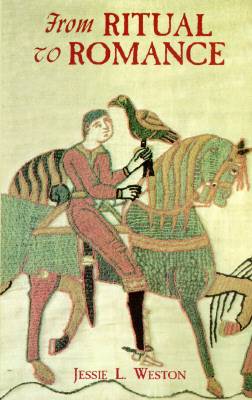
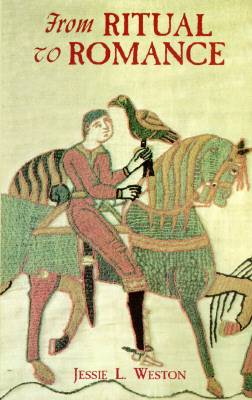
Description
Acknowledged by T. S. Eliot as one of the chief sources for his great poem "The Waste Land," Jessie L. Weston's From Ritual to Romance remains a landmark of anthropological and mythological scholarship. In this book she explores the origins of the Grail legend, arguing that it dates back to a primitive vegetation cult and only later was shaped by Celtic and Christian lore.
To prove her thesis, Weston unites folkloric and Christian elements by using printed texts to prove the parallels existing between each and every feature of the legend of the Holy Grail and the recorded symbolism of the ancient mystery cults. Specifically, she finds the origin of the Grail legend in a Gnostic text that served as a link between such cults and later Celtic and Christian elaborations of the myth.
With erudition and critical acumen, the author provides illuminating insights into diverse aspects of the legend: the task of the hero; the freeing of the waters; medieval and modern forms of nature ritual; the symbols of the cult (cup, lance, sword, stone, etc.); the symbolism of the fisher king; the significance of such deities as Tammuz, Adonis, Mithra, and Attis; the meaning of the adventure of the Perilous Chapel in Grail romances; and much more.
Awarded the Crawshay Prize in 1920, this scholarly yet highly readable study will interest any student of the Arthurian legends, mythology, ancient religion, and Eliot's poetry.
To prove her thesis, Weston unites folkloric and Christian elements by using printed texts to prove the parallels existing between each and every feature of the legend of the Holy Grail and the recorded symbolism of the ancient mystery cults. Specifically, she finds the origin of the Grail legend in a Gnostic text that served as a link between such cults and later Celtic and Christian elaborations of the myth.
With erudition and critical acumen, the author provides illuminating insights into diverse aspects of the legend: the task of the hero; the freeing of the waters; medieval and modern forms of nature ritual; the symbols of the cult (cup, lance, sword, stone, etc.); the symbolism of the fisher king; the significance of such deities as Tammuz, Adonis, Mithra, and Attis; the meaning of the adventure of the Perilous Chapel in Grail romances; and much more.
Awarded the Crawshay Prize in 1920, this scholarly yet highly readable study will interest any student of the Arthurian legends, mythology, ancient religion, and Eliot's poetry.
Spécifications
Parties prenantes
- Auteur(s) :
- Editeur:
Contenu
- Nombre de pages :
- 240
- Langue:
- Anglais
Caractéristiques
- EAN:
- 9780486296807
- Date de parution :
- 02-11-11
- Format:
- Livre broché
- Format numérique:
- Trade paperback (VS)
- Dimensions :
- 138 mm x 213 mm
- Poids :
- 249 g


Seulement chez Librairie Club
+ 40 points sur votre carte client de Librairie Club
Cadeau


Les avis
Nous publions uniquement les avis qui respectent les conditions requises. Consultez nos conditions pour les avis.