


- Retrait en 2 heures
- Assortiment impressionnant
- Paiement sécurisé
- Toujours un magasin près de chez vous
- Retrait en 2 heures
- Assortiment impressionnant
- Paiement sécurisé
- Toujours un magasin près de chez vous



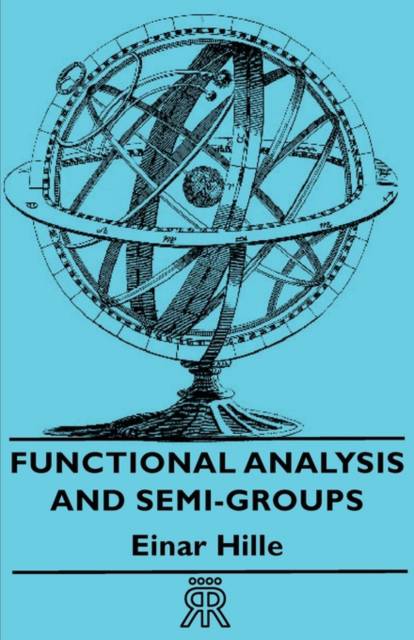
Description
AMERICAN MATHEMATICAL SOCIETY COLLOQUIUM PUBLICATIONS VOLUME XXXI FUNCTIONAL ANALYSIS AND SEMI-GROUPS BY EINAR HILLE PROFESSOR OF MATHEMATICS YALE UNIVERSITY PUBLISHED BY THE AMERICAN MATHEMATICAL SOCIETY 531 WEST 116iH STREET, NEW YORK CITY 1948 To KIRSTI And each man hears as the twilight nears, to the beat of his dying hearty The Devil drum on the darkened pane You did it, but was it Art FOREWORD The analytical theory of semi-groups is a recent addition to the ever-growing list of mathematical disciplines. It was my good fortune to take an early interest in this disci pline and to see it reach maturity. It has been a pleasant association I hail a semi-group when I see one and I seem to see them every where Friends have observed, however, that there are mathematical objects which are not semi-groups. The present book is an elaboration of my Colloquium Lectures delivered before the American Mathematical Society at its August, 1944 meeting at Wellesley College. I wish to thank the Society and its officers for their invitation to present and publish these lectures. The book is divided into three parts plus an appendix. My desire to give a practically self-contained presentation of the theory required the inclusion of an elaborate introduc tion to modern functional analysis with special emphasis on function theory in Banach spaces and algebras. This occupies Part One of the book and the Appendix these portions can be read separately from the rest and may be used as a text in a course on operator theory. It is possible to cover most of the material in these six chapters in two terms. The analytical theory of one-parameter semi-groups occupies Part Two while Part Three deals with the applications to analysis. The latter include such varied topics as trigonometric series and integrals, summability, fractional integration, stochastic theory, and the problem of Cauchy for partial differential equations. In the general theory the reader will also find an alternate approach to ergodic theory. All semi-groups studied in this treatise are referred to a normed topology semi-groups without topology figure in a few places but no details are given. The task of developing an adequate theory of trans formation semi-groups operating in partially ordered spaces is left to more competent hands. The literature has been covered rather incompletely owing to recent war conditions and to the wide range of topics touched upon, which have made it exceedingly difficult to give the proper credits. This investigation has been supported by grants from the American Philosophical Society and from Yale University which are gratefully acknowledged. On the personal side, it is a great pleasure to express my gratitude to the many friends who have aided me in pre paring this book. J. D. Tamarkin, who read and criticized my early work in the field and who vigorously urged its inclusion in the Colloquium Series is beyond the reach of my grati tude. I am deeply indebted to Nelson Dunford and to Max Zorn who have contributed extensively to the book, the former chiefly to Chapters II, III, V, VIII, IX, and XIV, the latter to Chapters IV, VII, and XXII. Both have given me generously of their time and special experience. Various portions of the manuscript have been critically examined and amended by Warren Ambrose, E. G. Begle, H. Cramdr, J. L. Doob, W. Feller, N. Jacobson, D. S. Miller, II. Pollard, C. E. Rickart, and I. E. Segal. To all helpers, named and un named, I extend my warmest thanks. EINAK HILLE New Haven, Conn., December, 1946 CONVENTIONS Each Part of the book starts with a Summary, each Chapter with an Orientation. The chapters are divided into sections and the sections, except orientations, are grouped into paragraphs. Cross references are normally to sections, rarely to paragraphs. Section 3.10 is the tenth section of Chapter III it belongs to 2 which is referred to as 3.2 when necessary...
Spécifications
Parties prenantes
- Auteur(s) :
- Editeur:
Contenu
- Nombre de pages :
- 542
- Langue:
- Anglais
Caractéristiques
- EAN:
- 9781406707311
- Date de parution :
- 15-03-2007
- Format:
- Livre broché
- Format numérique:
- Trade paperback (VS)
- Dimensions :
- 140 mm x 216 mm
- Poids :
- 703 g


Seulement chez Librairie Club
+ 100 points sur votre carte client de Librairie Club
Cadeau


Les avis
Nous publions uniquement les avis qui respectent les conditions requises. Consultez nos conditions pour les avis.