


- Retrait en 2 heures
- Assortiment impressionnant
- Paiement sécurisé
- Toujours un magasin près de chez vous
- Retrait en 2 heures
- Assortiment impressionnant
- Paiement sécurisé
- Toujours un magasin près de chez vous



Description
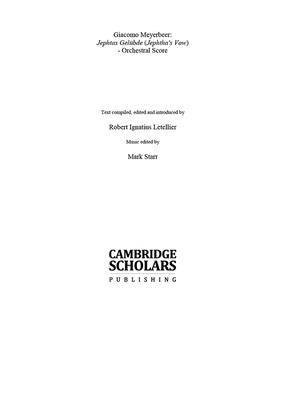
Meyerbeer's first opera, Jephtas Gelubde, has a libretto by the German academic Alois Schreiber, based on a Biblical theme taken from chapters 11-12 of the Book of Judges. The conflict between paternal love and love of country intrinsic to this story was is also the basic theme of the opera scenario, and is reflected in the overture, a symphonic anticipation of the essential features of the action. The opera, whose final rehearsals were conducted by the composer in person, was admirably produced by the Munich Court Opera on 23 December 1812, but on account of its novelty met with indifference, so that it was withdrawn. A newspaper report did, however, observe: A delicate sensibility, united to a profound and mature insight into the workings of the impassioned human heart, is manifested throughout in a grand and elevated style that gives promise of something great in the future. This score contains the seeds of the whole of Meyerbeer's future development. It is impossible to conceive of Meyerbeer's progress to mastership without the Jephta score. Meyerbeer was responding to the heritage of his predecessors the Handel of the oratorios (in the depiction of grandiose biblical drama), and the Gluck of the tragedie lyrique (in the depth of both public and private emotional exploration), but also alert to issues in contemporary opera, like the rescue motif and development of the villain. There is also evidence of Meyerbeer's famed orchestral virtuosity and imagination already at work. In his psychological exploration, Meyerbeer already begins to use thematic tagging and foreshadowing most imaginatively, and points the way far beyond Gluck, in the direction of Weber-Wagner. A performing edition of the opera has been prepared from the manuscript source: text by Robert Letellier, music by Mark Starr. Cambridge Scholars Publishing is printing the vocal score and the orchestral score. The orchestral parts are included in the catalogue of Noteworthy Musical Editions' Rental Library who make the parts available to opera companies for staged productions.
Spécifications
Parties prenantes
- Auteur(s) :
- Editeur:
Contenu
- Nombre de pages :
- 600
- Langue:
- Anglais
Caractéristiques
- EAN:
- 9781443832199
- Date de parution :
- 24-07-12
- Format:
- Livre relié
- Format numérique:
- Genaaid
- Dimensions :
- 203 mm x 305 mm
- Poids :
- 543 g


Seulement chez Librairie Club
+ 691 points sur votre carte client de Librairie Club
Cadeau


Les avis
Nous publions uniquement les avis qui respectent les conditions requises. Consultez nos conditions pour les avis.