


- Retrait en 2 heures
- Assortiment impressionnant
- Paiement sécurisé
- Toujours un magasin près de chez vous
- Retrait gratuit dans votre magasin Club
- 7.000.0000 titres dans notre catalogue
- Payer en toute sécurité
- Toujours un magasin près de chez vous



Description
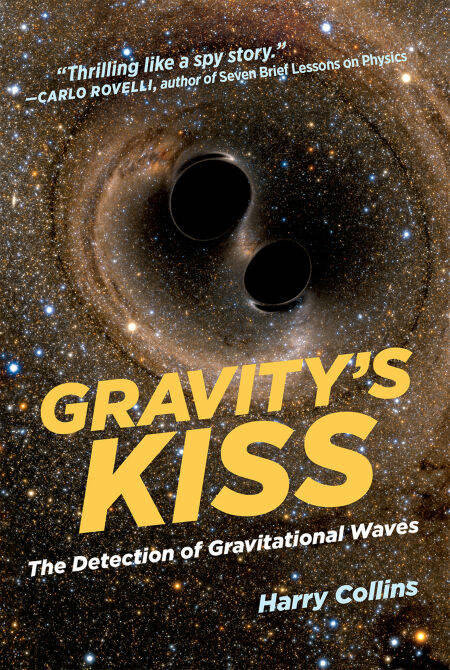
Written in real time, this fascinating account takes you inside a landmark scientific discovery, long in the making: the first detection of gravitational waves.
“Thrilling like a spy story.” —Carlo Rovelli, author of Seven Brief Lessons on Physics
Scientists have been trying to confirm the existence of gravitational waves for more than 50 years. Then, in September 2015, came a “very interesting event” (as the cautious subject line in a physicist’s email read) that proved to be the first detection of gravitational waves. In Gravity's Kiss, Harry Collins—who has been following the science for decades and has written three previous books about it—offers a final, fascinating account, written in real time, of the unfolding of one of the most remarkable scientific discoveries ever made.
Predicted by Einstein in his theory of general relativity, gravitational waves carry energy from the collision or explosion of stars. Dying binary stars, for example, rotate faster and faster around each other until they merge, emitting a burst of gravitational waves. It is only with the development of extraordinarily sensitive, highly sophisticated detectors that physicists can now confirm Einstein's prediction. This is the story that Collins tells.
Collins, a sociologist of science who has been embedded in the gravitational wave community since 1972, traces the detection, the analysis, the confirmation, and the public presentation and the reception of the discovery—from the first email to the final published paper and the response of professionals and the public. Collins shows that science today is collaborative, far-flung (with the physical location of the participants hardly mattering), and sometimes secretive, but still one of the few institutions that has integrity built into it.
“Thrilling like a spy story.” —Carlo Rovelli, author of Seven Brief Lessons on Physics
Scientists have been trying to confirm the existence of gravitational waves for more than 50 years. Then, in September 2015, came a “very interesting event” (as the cautious subject line in a physicist’s email read) that proved to be the first detection of gravitational waves. In Gravity's Kiss, Harry Collins—who has been following the science for decades and has written three previous books about it—offers a final, fascinating account, written in real time, of the unfolding of one of the most remarkable scientific discoveries ever made.
Predicted by Einstein in his theory of general relativity, gravitational waves carry energy from the collision or explosion of stars. Dying binary stars, for example, rotate faster and faster around each other until they merge, emitting a burst of gravitational waves. It is only with the development of extraordinarily sensitive, highly sophisticated detectors that physicists can now confirm Einstein's prediction. This is the story that Collins tells.
Collins, a sociologist of science who has been embedded in the gravitational wave community since 1972, traces the detection, the analysis, the confirmation, and the public presentation and the reception of the discovery—from the first email to the final published paper and the response of professionals and the public. Collins shows that science today is collaborative, far-flung (with the physical location of the participants hardly mattering), and sometimes secretive, but still one of the few institutions that has integrity built into it.
Spécifications
Parties prenantes
- Auteur(s) :
- Editeur:
Contenu
- Nombre de pages :
- 416
- Langue:
- Anglais
- Collection :
Caractéristiques
- EAN:
- 9780262340052
- Date de parution :
- 19-01-17
- Format:
- Ebook
- Protection digitale:
- Adobe DRM
- Format numérique:
- ePub


Seulement chez Librairie Club
+ 19 points sur votre carte client de Librairie Club
Cadeau

Cadeau


Les avis
Nous publions uniquement les avis qui respectent les conditions requises. Consultez nos conditions pour les avis.