


- Retrait en 2 heures
- Assortiment impressionnant
- Paiement sécurisé
- Toujours un magasin près de chez vous
- Retrait en 2 heures
- Assortiment impressionnant
- Paiement sécurisé
- Toujours un magasin près de chez vous



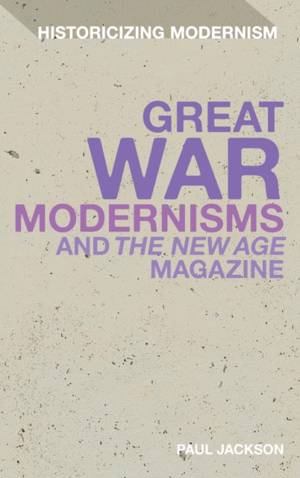
Description
The literary magazine The New Age brought
together a diverse set of intellectuals. Against the backdrop of the First
World War, they chose to write about more than modernist art and aesthetics. By
closely reading and contextualizing their contributions, Paul Jackson's study
engages with the political and philosophical responses of literary artists to
modernity. Jackson demonstrates the need to interpret modernism not merely as an
aesthetic phenomenon, but inherently linked to politics and philosophy.
By placing the writing of a canonical modernist, Wyndham Lewis, against a
figure usually excluded from the modernist canon, H.G. Wells, Jackson examines
further a wartime modernism that embraced socialist and political views. This
reinterpretation of modernism provides a historicised understanding of the
politicised hopes of artists promoting revolutionary forms of cultural renewal.
Considering modernist writers' relationship between politics, philosophy and
aesthetics in the context of total war Jackson encourages new
cultural-historical definitions of modernism. In addition this study provides
the first close analysis of cultural contributions from a leading wartime
Little Magazine, tracing the radical modernist debates that developed in its
pages.
Spécifications
Parties prenantes
- Auteur(s) :
- Editeur:
Contenu
- Nombre de pages :
- 192
- Langue:
- Anglais
- Collection :
Caractéristiques
- EAN:
- 9781441180087
- Date de parution :
- 13-09-12
- Format:
- Livre relié
- Format numérique:
- Genaaid
- Dimensions :
- 157 mm x 236 mm
- Poids :
- 430 g


Seulement chez Librairie Club
+ 644 points sur votre carte client de Librairie Club
Cadeau

Cadeau


Les avis
Nous publions uniquement les avis qui respectent les conditions requises. Consultez nos conditions pour les avis.