


- Retrait en 2 heures
- Assortiment impressionnant
- Paiement sécurisé
- Toujours un magasin près de chez vous
- Retrait en 2 heures
- Assortiment impressionnant
- Paiement sécurisé
- Toujours un magasin près de chez vous



51,95 €
+ 103 points
Description
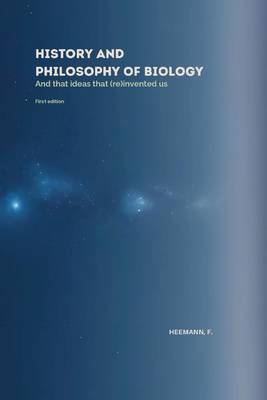
What does it mean to know life? Not to catalogue it, sequence it, or model it - but to understand how the very act of knowing transformed what life means to us, and what we mean to ourselves.
History and Philosophy of Biology traces the conceptual fault lines beneath five centuries of biological thought: from Galen's humoral cosmos to Darwin's radical contingency, from Mendel's silent peas to the fractal geometries of living systems. Each breakthrough examined here is not merely a discovery - it is a rupture in the framework through which a civilization understood its own existence.
Structured in five acts and twenty movements, Felipe Heemann A. Ribeiro guides readers through the tensions that modern biology rarely acknowledges: between mechanism and emergence, between reductionism and complexity, between the physician's gaze and the organism's irreducible becoming. Science, here, is not backdrop - it is the protagonist of a philosophical drama still unresolved.
For those who seek not only to know, but to interrogate the very ground on which knowing stands.
Spécifications
Parties prenantes
- Auteur(s) :
- Editeur:
Contenu
- Nombre de pages :
- 172
- Langue:
- Anglais
- Collection :
- Tome:
- n° 4
Caractéristiques
- EAN:
- 9786598812638
- Date de parution :
- 19-10-25
- Format:
- Livre broché
- Format numérique:
- Trade paperback (VS)
- Dimensions :
- 152 mm x 229 mm
- Poids :
- 317 g


Seulement chez Librairie Club
+ 103 points sur votre carte client de Librairie Club
Cadeau


Les avis
Nous publions uniquement les avis qui respectent les conditions requises. Consultez nos conditions pour les avis.