


En raison d'une grève chez bpost, des retards de livraison peuvent survenir. Besoin de quelque chose en urgence ? Optez pour un retrait en magasin ou rendez-vous dans une Librairie Club à proximité.
- Retrait en 2 heures
- Assortiment impressionnant
- Paiement sécurisé
- Toujours un magasin près de chez vous
En raison d'une grève chez bpost, des retards de livraison peuvent survenir. Besoin de quelque chose en urgence ? Optez pour un retrait en magasin ou rendez-vous dans une Librairie Club à proximité.
- Retrait en 2 heures
- Assortiment impressionnant
- Paiement sécurisé
- Toujours un magasin près de chez vous


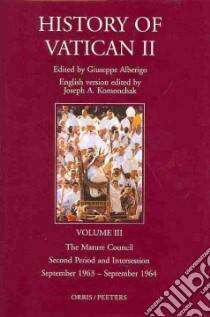
History of Vatican II, Vol. III. the Mature Council. Second Period and Intersession. September 1963 - September 1964
Giuseppe Alberigo
70,00 €
+ 140 points
Description
This third volume of the History of Vatican II describes the period during which the Second Vatican Council began to assume its mature and distinct character. With the succession of Pope Paul VI to Pope John XXIII the Council had a new head. With the revisions of texts accomplished during the firts intersession the council had a new agenda more in line with the desires of the majority that had emerged during the first period. With the appointment of four Moderators the Council had a new leadership. The volume describes the peculiar situation of Paul VI as a pope elected in the midst of an ecumenical council and the vision of the Council - and the Church - that he outlined in his opening speech, which was followed immediately by a consideration of the text on the Church. Both in this discussion and in the one that followed, on bishops, the issue of collegiality would be passionately debated. The Council also completed its work on the first two documents promulgated: the Constitution on the Sacred Liturgy and the Declaration on the Communications Media. The ecumenical commitment of the Council became visible, not only in the discussion of a decree on ecumenism, but in the visit of Paul VI to the Holy Land. During the second intersession the work of the Council continued, the most important features of which were the beginnings of the liturgical reform, the revision of the major texts still to be considered or voted on, and a plan to reduce many other texts to simple sets of propositions that was designed to make it possible for the Council to end with the third period.
Spécifications
Parties prenantes
- Auteur(s) :
- Editeur:
Contenu
- Nombre de pages :
- 514
- Langue:
- Anglais
- Collection :
Caractéristiques
- EAN:
- 9789042908482
- Date de parution :
- 07-06-00
- Format:
- Livre relié
- Format numérique:
- Genaaid
- Dimensions :
- 168 mm x 246 mm
- Poids :
- 1338 g


Seulement chez Librairie Club
+ 140 points sur votre carte client de Librairie Club
Cadeau


Les avis
Nous publions uniquement les avis qui respectent les conditions requises. Consultez nos conditions pour les avis.