


- Retrait en 2 heures
- Assortiment impressionnant
- Paiement sécurisé
- Toujours un magasin près de chez vous
- Retrait en 2 heures
- Assortiment impressionnant
- Paiement sécurisé
- Toujours un magasin près de chez vous



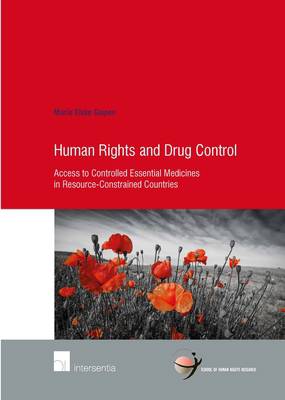
Human Rights and Drug Control
Access to Controlled Essential Medicines in Resource-Constrained Countries Volume 80
Marie Gispen
94,00 €
+ 188 points
Description
Globally, millions of people suffer health and socio-economic related problems due to the unavailability of controlled essential medicines such as morphine for pain treatment, which leaves them in disabling and sometimes degrading situations. Controlled essential medicines are medicines included in the World Health Organization's List of Essential Medicines, and whose active substance is listed under the international drug-control treaties. Their availability and accessibility therefore fall within the remit of both human rights and international drug-control law. Even though the unavailability of controlled essential medicines is generally caused by a multifaceted and complex interplay of factors, the current international drug-control framework paradoxically hinders rather than fosters the access to medicines.Human Rights and Drug Control analyses a human rights interpretation of the international drug-control framework with an emphasis on advancing the access to controlled essential medicines in resource-constrained countries. Its approach goes beyond the more conventional legal analysis and includes an ethical analysis as well as two case studies in Uganda and Latvia. It first aims to identify a human rights foundation of drug control by examining how human rights norms would balance the underlying tension: some controlled substances have a clear, evidence-based medical benefit, yet also have the potential to be misused, which may lead to dependency disorders. This makes it evident that States should regulate this delicate equilibrium, the challenge being how they can do so legitimately in light of human rights norms.Having explored this premise in the context of human rights law and theory, this book then applies these findings to Uganda and Latvia, two 'best practice' countries when it comes to improving the accessibility of morphine for pain treatment. Relying on qualitative research methods, the study explores whether the human rights basis of drug-control regulation may be adequately integrated into the structures of the present international drug-control system. It specifically deals with various technical, administrative and procedural obligations relating to the import/export and retail trade of controlled medicines. The book concludes with a proposal on how a human rights approach to drug-control may be advanced, specifically highlighting the importance of reconciling international obligations with the local reality in which these obligations come into play.
Spécifications
Parties prenantes
- Auteur(s) :
- Editeur:
Contenu
- Nombre de pages :
- 352
- Langue:
- Anglais
- Collection :
- Tome:
- n° 80
- Illustré:
- Oui
Caractéristiques
- EAN:
- 9781780684543
- Date de parution :
- 27-01-17
- Format:
- Livre broché
- Format numérique:
- Trade paperback (VS)
- Dimensions :
- 170 mm x 240 mm
- Poids :
- 671 g


Seulement chez Librairie Club
+ 188 points sur votre carte client de Librairie Club
Cadeau


Les avis
Nous publions uniquement les avis qui respectent les conditions requises. Consultez nos conditions pour les avis.