


- Retrait en 2 heures
- Assortiment impressionnant
- Paiement sécurisé
- Toujours un magasin près de chez vous
- Retrait gratuit dans votre magasin Club
- 7.000.0000 titres dans notre catalogue
- Payer en toute sécurité
- Toujours un magasin près de chez vous



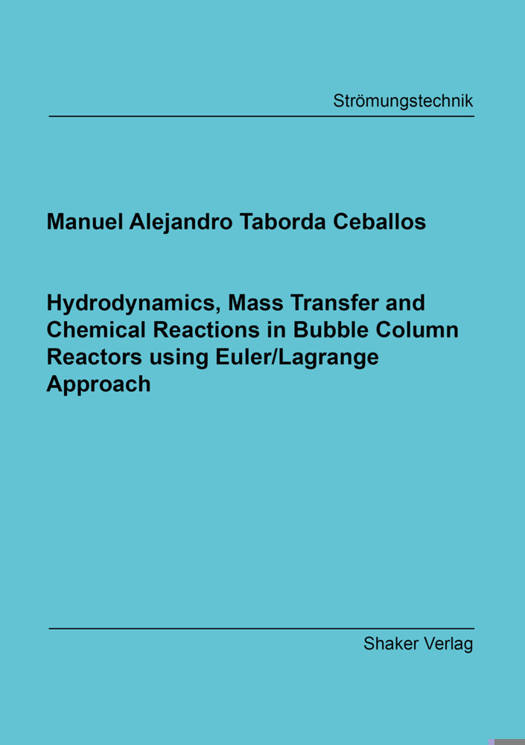
Hydrodynamics, Mass Transfer and Chemical Reactions in Bubble Column Reactors using Euler/Lagrange Approach
Dissertationsschrift
Manuel Alejandro Taborda Ceballos
48,45 €
+ 96 points
Description
Bubble columns are complex multiphase reactors that are employed in various industrial processes. These types of reactors are used to bring gas and a liquid or suspension into interaction producing large contact areas for mass transfer and subsequent chemical reactions. Due to their great importance for chemical, biochemical, pharmaceutical, and petrochemical industries, engineers have always pursued to increase their performance. For allowing a deeper insight into this complexity and providing strategies for process optimization, CFD (computational fluid dynamics) has become a standard numerical tool. However, accurate models are needed to correctly reproduce such dynamic systems. Latter can be explained by the complexity of the interrelations of the concerned phenomena, which take place during the operation of bubble columns, in addition to the several magnitudes in both, length as well as time scale involved in the physical phenomena.The Euler/Lagrange approach is an attractive and descriptive method for numerically computing large-scale dispersed multi-phase flows, such as reactive bubbly flows, where however the dispersed phase elements are treated as point-masses. This approach was extended in the present study in order to account for finite size effects, specifically shape and trajectory oscillations as well as the resulting dynamic mass transfer, which is essential in reactive bubbly flows. The flow field was computed by the Large Eddy Simulation (LES) concept with full two-way coupling in momentum and the modelled sub-grid-scale (SGS) turbulence. In addition, turbulence enhancement and dissipation by the bubbles, known as bubble-induced turbulence (BIT) was also considered. Bubble motion was calculated including all relevant forces (i.e., drag, lift, wall force, added mass, gravity/buoyancy, fluid inertia and Basset force), which were extended considering the modelled instantaneous bubble eccentricity and also incorporating bubble transport by the SGS turbulence. Mass transfer was modelled accounting for the bubble dynamic behaviour (i.e., shape oscillations), and the influence of chemical reactions on species consumption within the liquid phase was modelled through the enhancement factor.For validating the model extensions thorough numerical computations were conducted for several experimental test cases with air and N2 bubbles as well as CO2 absorption followed by chemical reactions considering single bubble rise and bubble swarms in laboratory bubble columns. Furthermore, simulations of Fe(edta)-NO system, based on a system studied only for single bubbles, is presented here numerically for a bubble column.It is demonstrated that for point-particle approaches the modelling of bubble dynamics in motion and mass transfer is essential for accurate predictions. Only with this extension it is possible to obtain correct bubble lateral dispersion (i.e., bubble fluctuating velocities) and a remarkably higher mass transfer provoked by the larger surface area of deformed bubbles. Thereby, bubble and liquid velocities, gas volume fraction as well as bubble size distribution variations along the bubble column in a reactive system can be predicted with a very good agreement compared to experimental measurements. Therefore, the transient evolution of species concentration in the column occurred much faster when considering the bubble dynamics model, which results in a better agreement with the measured quantities, such as pH variation.Finally, a CFD algorithm was developed for the numerical modelling of three-dimensional bubble columns reactors, which are operated at the homogeneous or heterogeneous flow regime. In this way, the algorithm is based on the open-source software package OpenFOAM® and follows a two-way coupled LES Euler-Lagrange (EL) approach, which can be made accessible to the scientific community.
Spécifications
Parties prenantes
- Auteur(s) :
- Editeur:
Contenu
- Nombre de pages :
- 157
- Langue:
- Anglais
- Collection :
Caractéristiques
- EAN:
- 9783844085648
- Format:
- Livre broché
- Dimensions :
- 149 mm x 8 mm
- Poids :
- 184 g


Seulement chez Librairie Club
+ 96 points sur votre carte client de Librairie Club

Les avis
Nous publions uniquement les avis qui respectent les conditions requises. Consultez nos conditions pour les avis.