


- Retrait en 2 heures
- Assortiment impressionnant
- Paiement sécurisé
- Toujours un magasin près de chez vous
- Retrait en 2 heures
- Assortiment impressionnant
- Paiement sécurisé
- Toujours un magasin près de chez vous



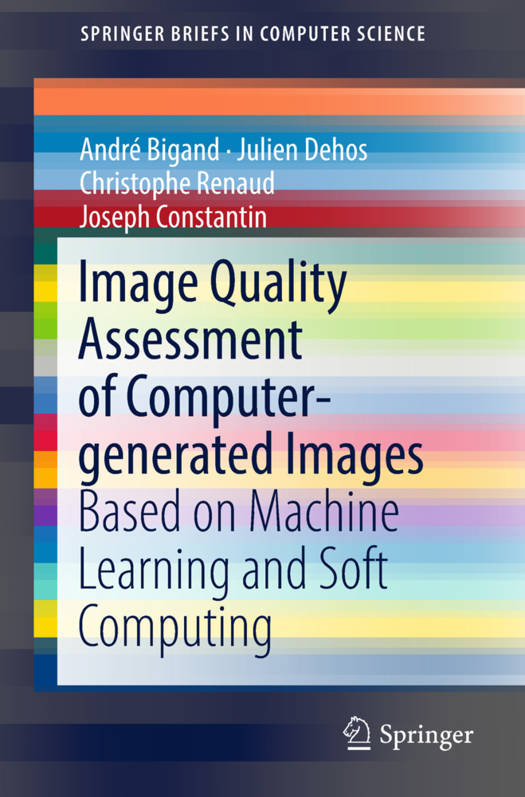
Image Quality Assessment of Computer-Generated Images
Based on Machine Learning and Soft Computing
André Bigand, Julien Dehos, Christophe Renaud, Joseph Constantin
53,45 €
+ 106 points
Description
Image Quality Assessment is well-known for measuring the perceived image degradation of natural scene images but is still an emerging topic for computer-generated images. This book addresses this problem and presents recent advances based on soft computing. It is aimed at students, practitioners and researchers in the field of image processing and related areas such as computer graphics and visualization.
In this book, we first clarify the differences between natural scene images and computer-generated images, and address the problem of Image Quality Assessment (IQA) by focusing on the visual perception of noise. Rather than using known perceptual models, we first investigate the use of soft computing approaches, classically used in Artificial Intelligence, as full-reference and reduced-reference metrics. Thus, by creating Learning Machines, such as SVMs and RVMs, we can assess the perceptual quality of a computer-generated image. We also investigate the use of interval-valuedfuzzy sets as a no-reference metric.These approaches are treated both theoretically and practically, for the complete process of IQA. The learning step is performed using a database built from experiments with human users and the resulting models can be used for any image computed with a stochastic rendering algorithm. This can be useful for detecting the visual convergence of the different parts of an image during the rendering process, and thus to optimize the computation. These models can also be extended to other applications that handle complex models, in the fields of signal processing and image processing.
Spécifications
Parties prenantes
- Auteur(s) :
- Editeur:
Contenu
- Nombre de pages :
- 88
- Langue:
- Anglais
- Collection :
Caractéristiques
- EAN:
- 9783319735429
- Date de parution :
- 19-03-18
- Format:
- Livre broché
- Format numérique:
- Trade paperback (VS)
- Dimensions :
- 156 mm x 234 mm
- Poids :
- 158 g


Seulement chez Librairie Club
+ 106 points sur votre carte client de Librairie Club
Cadeau


Les avis
Nous publions uniquement les avis qui respectent les conditions requises. Consultez nos conditions pour les avis.