


- Retrait en 2 heures
- Assortiment impressionnant
- Paiement sécurisé
- Toujours un magasin près de chez vous
- Retrait en 2 heures
- Assortiment impressionnant
- Paiement sécurisé
- Toujours un magasin près de chez vous



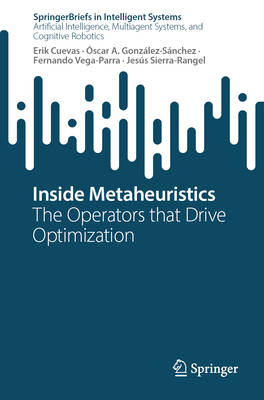
Inside Metaheuristics
The Operators That Drive Optimization
Erik Cuevas, Óscar A González-Sánchez, Fernando Vega-Parra, Jesús Sierra-Rangel
54,45 €
+ 108 points
Description
This book provides a comprehensive and structured exploration of the fundamental mechanisms that govern metaheuristic optimization methods. Rather than cataloging existing algorithms, it focuses on the building blocks the operators and strategies that enable metaheuristics to efficiently navigate complex search spaces. By analyzing the principles of exploration, exploitation, and their dynamic interaction, the book reveals how the balance between these processes determines algorithmic performance, convergence, and robustness.
The book introduces the theoretical foundations of optimization and the architecture common to most metaheuristic algorithms. Readers are guided through the core concepts of search space analysis, stochastic behavior, and the general structure shared by population-based methods. This foundation prepares the ground for a detailed examination of how exploration and exploitation operate as complementary forces within optimization processes. Exploration operators such as randomization, chaotic dynamics, opposition-based learning, and mutation are presented as tools for promoting diversity and global discovery. The authors then focuse on exploitation, examining how greedy selection, local refinement, leader-based attraction, and adaptive step-size control enhance convergence toward high-quality solutions. The discussion subsequently extends to dual-role operators that integrate both behaviors, including crossover and hybrid recombination, demonstrating how they dynamically shift between global and local search depending on the problem landscape.
The final chapters synthesize these ideas to show how combinations of operators can be strategically designed to create hybrid and adaptive metaheuristics. Readers will learn how operator synergy influences performance, how hybrid frameworks can integrate complementary search mechanisms, and how self-adaptive strategies allow algorithms to evolve their own balance between exploration and exploitation.
By shifting the focus from individual algorithm names to the mechanisms that make them work, this book provides a unified framework for understanding, comparing, and designing metaheuristic methods. It equips readers with the conceptual tools to analyze the internal dynamics of optimization processes and to construct their own customized search strategies for complex real-world problems.
Written in a clear and accessible style, this book is intended for graduate students, researchers, and practitioners in computer science, engineering, and applied mathematics who wish to deepen their understanding of metaheuristic design principles and develop more efficient, adaptive optimization algorithms.
Spécifications
Parties prenantes
- Auteur(s) :
- Editeur:
Contenu
- Nombre de pages :
- 157
- Langue:
- Anglais
- Collection :
Caractéristiques
- EAN:
- 9783032292476
- Date de parution :
- 31-07-26
- Format:
- Livre broché
- Format numérique:
- Trade paperback (VS)
- Dimensions :
- 155 mm x 235 mm


Seulement chez Librairie Club
+ 108 points sur votre carte client de Librairie Club
Cadeau


Les avis
Nous publions uniquement les avis qui respectent les conditions requises. Consultez nos conditions pour les avis.