


- Retrait en 2 heures
- Assortiment impressionnant
- Paiement sécurisé
- Toujours un magasin près de chez vous
- Retrait en 2 heures
- Assortiment impressionnant
- Paiement sécurisé
- Toujours un magasin près de chez vous



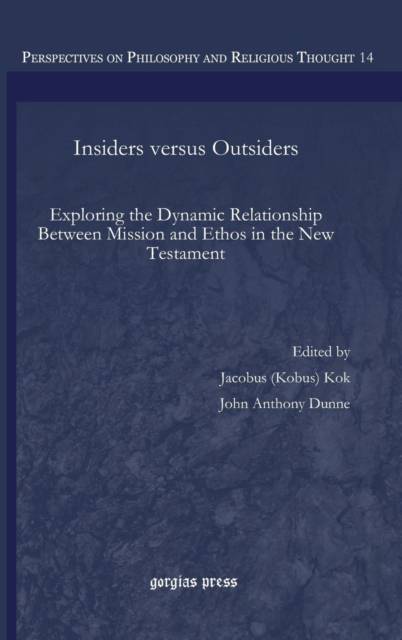
Insiders Versus Outsiders
Exploring the Dynamic Relationship Between Mission and Ethos in the New Testament
161,45 €
+ 322 points
Description
In times of conflict and radical change, group identity is often threatened and boundaries need to be renegotiated. The first century was a time of radical change, especially for the Jews. It was in the first century C.E. that the core symbol of Jewish identity, the temple, was destroyed. Social scientists point out that in such turbulent times, groups will often create stronger boundaries around themselves. In such contexts boundaries between insiders and outsiders are created and in ancient texts, expressed in linguistic forms that illustrate such boundaries. Christianity as a movement developed within the already established, but volatile Jewish movement/religion. As a movement Christianity expressed a profound sense of inclusivism and illustrated that value in the transcendence of social boundaries. However, Christianity was also a moral movement, as Wayne Meeks once remarked, and therefore also created boundaries. This is expressed in linguistic expressions, such as to say that the in-group are the pistoi (believers) to be distinguished from the apistoi (the unbelievers). In this book the dynamic reality of creating and transcending boundaries and the relationship between insiders and outsiders are explored by way of reflecting on mission and ethos. Mission is understood as the expansion of early Christianity which was experienced as a (missionary) call or responsibility to share a particular view on God and life. Ethos is understood as the language and behaviour that flowed forth from a missionary understanding of identity. Prof. Jacobus (Kobus) Kok is Associate Professor of New Testament Studies at the University of Pretoria and Doctoral Researcher in Religious Studies at the Radboud University Nijmegen in the Netherlands.
Spécifications
Parties prenantes
- Editeur:
Contenu
- Nombre de pages :
- 306
- Langue:
- Anglais
- Collection :
Caractéristiques
- EAN:
- 9781463202576
- Date de parution :
- 01-04-14
- Format:
- Livre relié
- Format numérique:
- Genaaid
- Dimensions :
- 152 mm x 229 mm
- Poids :
- 616 g


Seulement chez Librairie Club
+ 322 points sur votre carte client de Librairie Club
Cadeau


Les avis
Nous publions uniquement les avis qui respectent les conditions requises. Consultez nos conditions pour les avis.