


- Retrait en 2 heures
- Assortiment impressionnant
- Paiement sécurisé
- Toujours un magasin près de chez vous
- Retrait en 2 heures
- Assortiment impressionnant
- Paiement sécurisé
- Toujours un magasin près de chez vous



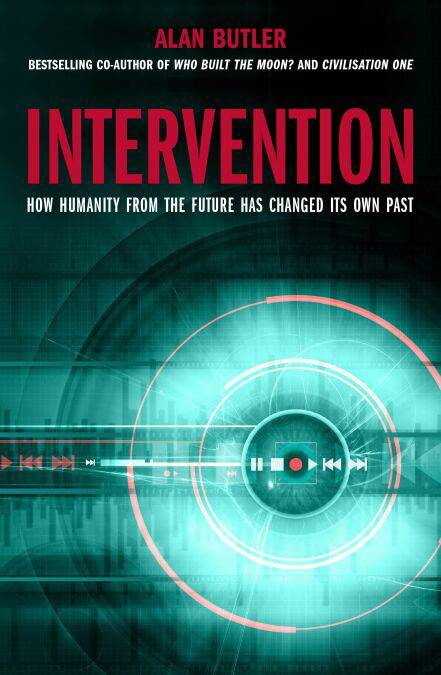
Intervention EBOOK
How Humanity from the Future Has Changed Its Own Past
Alan Butler
Ebook | Anglais
8,86 €
+ 8 points
Description
Alan Butler provides scientific evidence for time travel not only being real, but having already happened. Many key events in the history of humankind show evidence of having been intended by human beings from the future, who took specific actions that would steer the world in a particular direction. This 'intervention' theory is based on sound mathematical and scientific arguments, consistent with Einstein's demonstration of the possibility of time travel. Time travellers - some of them anonymous, some celebrated in history - have made alterations to our planetary and global environment (the creation of the Moon, the extinction of the dinosaurs) that were necessary to allow us to exist and to develop as an intelligent species. They have also left us markers that show what steps we need to take to progress further. All these interventions were placed retroactively within the 'timeline' for future generations, not for those immediately affected. Key interventions include: The creation of the Moon If the Moon did not exist, nor would we. The author demonstrates that the Moon was built to make it possible for the Earth to become an incubator of life.
The metal revolution The development of humanity's mastery over metal is a mystery, since the required temperatures for smelting metal exceeded anything that Neolithic man would have needed for any purpose. So how and why did smelting start? Add to that the fact that the first usable metal, bronze, is an alloy of copper and the much rarer tin and we begin to see the scale of the puzzle. Intervention supplies a convincing answer. The megalithic yard Neolithic peoples created a sophisticated, fully integrated system of measurements based on the actual size and mass of the Earth - a 'marker' for future scientific developments, surfacing again, apparently out of the blue, in 18th-century Washington, DC. But the most spectacular revelation lies in our future. By looking at the mathematics underlying many of the inventions, we discover, with unexpected precision, when our first contact with our future selves will happen. This will occur within the lifetime of most readers of this extraordinary book.
The metal revolution The development of humanity's mastery over metal is a mystery, since the required temperatures for smelting metal exceeded anything that Neolithic man would have needed for any purpose. So how and why did smelting start? Add to that the fact that the first usable metal, bronze, is an alloy of copper and the much rarer tin and we begin to see the scale of the puzzle. Intervention supplies a convincing answer. The megalithic yard Neolithic peoples created a sophisticated, fully integrated system of measurements based on the actual size and mass of the Earth - a 'marker' for future scientific developments, surfacing again, apparently out of the blue, in 18th-century Washington, DC. But the most spectacular revelation lies in our future. By looking at the mathematics underlying many of the inventions, we discover, with unexpected precision, when our first contact with our future selves will happen. This will occur within the lifetime of most readers of this extraordinary book.
Spécifications
Parties prenantes
- Auteur(s) :
- Editeur:
Contenu
- Nombre de pages :
- 198
- Langue:
- Anglais
Caractéristiques
- EAN:
- 9781780284255
- Date de parution :
- 31-12-11
- Format:
- Ebook
- Protection digitale:
- Adobe DRM
- Format numérique:
- ePub



Seulement chez Librairie Club
+ 8 points sur votre carte client de Librairie Club
Cadeau


Les avis
Nous publions uniquement les avis qui respectent les conditions requises. Consultez nos conditions pour les avis.