


- Retrait en 2 heures
- Assortiment impressionnant
- Paiement sécurisé
- Toujours un magasin près de chez vous
- Retrait en 2 heures
- Assortiment impressionnant
- Paiement sécurisé
- Toujours un magasin près de chez vous



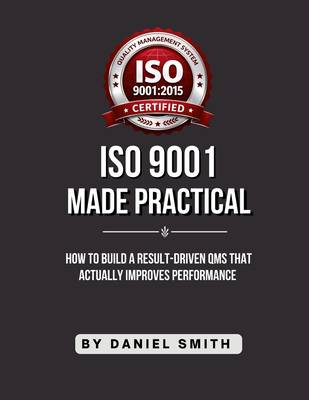
ISO 9001 Made Practical
How to Build a Result-Driven QMS that Actually Improves Performance
Daniel Smith
Livre broché | Anglais
54,45 €
+ 108 points
Description
ISO 9001 Made PracticalHow to Build a Result-Driven QMS that Actually Improves PerformanceBook Description
ISO 9001 Made Practical is a professional, easy-to-understand guide designed for learners, managers, consultants, auditors, and business professionals who want to understand ISO 9001 beyond theory. The book explains how to build a practical, result-driven Quality Management System that supports real business performance, customer satisfaction, process control, risk-based thinking, continual improvement, and certification readiness.
Instead of presenting ISO 9001 as only a documentation requirement, this book focuses on how organizations can use the standard as a practical management system. It explains how quality objectives, process ownership, documented information, KPIs, internal audits, corrective actions, and management review can work together to reduce errors, improve consistency, strengthen customer trust, and support long-term business improvement.
Chapter 1: Fundamentals & Value of ISO 9001This chapter introduces the purpose and business value of ISO 9001. It explains why organizations need a structured Quality Management System, how ISO 9001 has evolved, and how tools such as PDCA, risk-based thinking, and Cost of Poor Quality can help organizations improve performance.
Chapter 2: Building the QMS Structure Step by StepThis section explains how to design a practical QMS architecture. It covers process hierarchy, documented information, SOP design, process ownership, process mapping, SIPOC diagrams, and the difference between policies, procedures, SOPs, and work instructions.
Chapter 3: ISO 9001 Clauses Explained PragmaticallyThis chapter explains ISO 9001 clauses in a clear and business-focused way. It covers the practical meaning of clauses 4 to 10, including context of the organization, leadership, planning, support, operation, performance evaluation, and improvement.
Chapter 4: QMS Improvement Tools, KPI Design & Data CultureThis section focuses on improvement tools and performance measurement.
Chapter 5: Internal Audit, Nonconformities & Certification SuccessThis chapter guides readers through internal auditing, audit preparation, nonconformity management, corrective action, root-cause analysis, certification readiness, and how to demonstrate that the QMS is working effectively in real practice.
Who This Book Is ForThis book is suitable for:
- Quality managers and QMS coordinators
- Internal auditors and lead auditor learners
- ISO 9001 consultants
- Business owners and operational managers
- Compliance and process improvement professionals
- Students learning quality management systems
- Organizations preparing for ISO 9001 certification
This book is provided for educational and professional learning purposes. Organizations should adapt the concepts, templates, and examples according to their own business context, industry requirements, customer expectations, legal obligations, and certification objectives.
Spécifications
Parties prenantes
- Auteur(s) :
- Editeur:
Contenu
- Nombre de pages :
- 96
- Langue:
- Anglais
Caractéristiques
- EAN:
- 9798295891571
- Date de parution :
- 10-05-26
- Format:
- Livre broché
- Format numérique:
- Trade paperback (VS)
- Dimensions :
- 216 mm x 279 mm
- Poids :
- 317 g


Seulement chez Librairie Club
+ 108 points sur votre carte client de Librairie Club
Cadeau


Les avis
Nous publions uniquement les avis qui respectent les conditions requises. Consultez nos conditions pour les avis.