


- Retrait en 2 heures
- Assortiment impressionnant
- Paiement sécurisé
- Toujours un magasin près de chez vous
- Retrait en 2 heures
- Assortiment impressionnant
- Paiement sécurisé
- Toujours un magasin près de chez vous



135,95 €
+ 271 points
Description
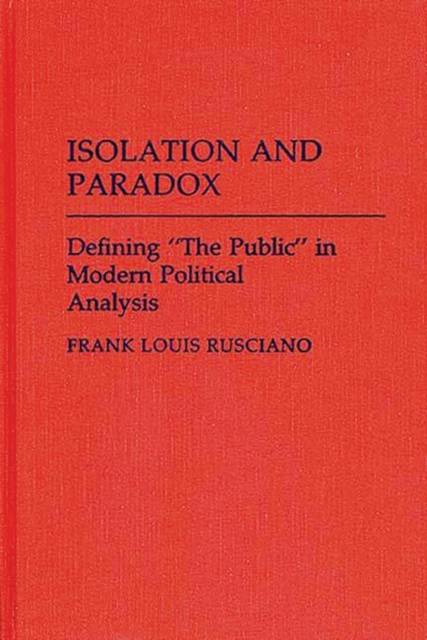
The controlling idea for this study, and a major theme in classical and modern social analysis, is the distinction between public and private sectors in liberal societies. Professor Rusciano's purpose is to consider how the common ground defined by the use of the notion public in public opinion and public choice can lead to a revitalization of the term in modern social analysis. In Chapter 1, the author shows that no public choice procedure may distinguish consistently between public and private issues, public and private goods, and public and private decision rules. He also shows that no procedure may consistently define the public realm implied by the term public choice. To illustrate this problem, the author scrutinizes three paradoxes of public choice: Arrow's General Possibility theorem, Olson's logic of collective action, and Barry's problem of legitimizing responsive choice procedures. Succeeding chapters discuss the definition of public advanced in Elisabeth Noelle-Neumann's spiral of silence theory of public opinion; elaborate on the notion of public and the Arrow problem; and apply the theorems derived from Noelle-Neumann's theory to the three paradoxes of public choice. Chapter 5 theoretically applies the argument developed in previous chapters to economic behavior through a critique of Fred Hirsch's Social Limits to Growth and to the problem of collective action. The chapter concludes with a formal model and three hypotheses which are tested in Chapters 6 and 7 through empirical analyses of classic problems in collective action and choice, and as models of a revised notion of social preference. Finally, the revised notion is illustrated by observations about consumer behavior, conventions of language, and the definitions and functions of social and state institutions.
Isolation and Paradox evolved from lectures and seminars delivered while Professor Rusciano was Visiting Professor at the Institut fur Publizistik at the University of Mainz, the German Federal Republic. Political and social scientists, as well as students in political theory, contemporary political analysis, comparative politics, public opinion, and political methodology will find this careful, logical study and its full complement of tables and charts necessary and informative reading.Spécifications
Parties prenantes
- Auteur(s) :
- Editeur:
Contenu
- Nombre de pages :
- 192
- Langue:
- Anglais
- Collection :
Caractéristiques
- EAN:
- 9780313264924
- Date de parution :
- 26-06-89
- Format:
- Livre relié
- Format numérique:
- Genaaid
- Dimensions :
- 156 mm x 234 mm
- Poids :
- 449 g


Seulement chez Librairie Club
+ 271 points sur votre carte client de Librairie Club
Cadeau


Les avis
Nous publions uniquement les avis qui respectent les conditions requises. Consultez nos conditions pour les avis.