


- Retrait en 2 heures
- Assortiment impressionnant
- Paiement sécurisé
- Toujours un magasin près de chez vous
- Retrait en 2 heures
- Assortiment impressionnant
- Paiement sécurisé
- Toujours un magasin près de chez vous



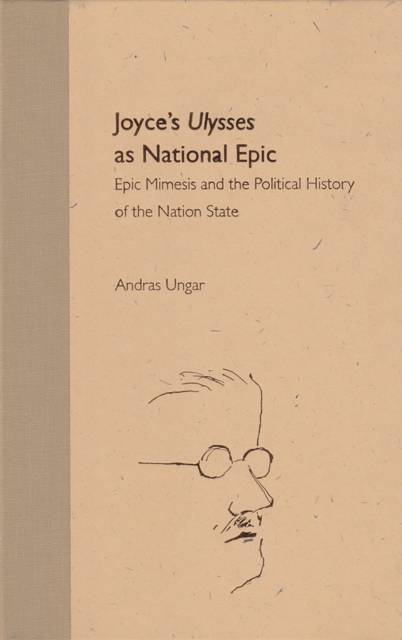
Joyce's Ulysses as National Epic
Epic Mimesis and the Political History of the Nation State
Andras Ungar
Livre broché | Anglais
50,45 €
+ 100 points
Description
"An incisive piece of criticism that offers, in an elegant set of readings, new insights into "Ulysses" as an epic of Irish nationhood. It adds significantly to our understanding of how Joyce's "Ulysses," by being national first, is international in the end, by showing how a text produced at a moment of Ireland's achievement of independence can offer a model of new nationhood to the world."--Enda Duffy, University of California, Santa Barbara "Although much has been written recently on the subject of Joyce and history, this illuminating book fills an important critical gap by examining how "Ulysses" construes the 'epic' as a distinctive discursive domain for historiography."--Dominic Manganiello, University of Ottawa Ungar argues that Joyce's "Ulysses" is the Irish national epic--a new national epic written at the moment a new nation, the Irish Free State, was being founded, and one that evades the potential constraints of the epic tradition in order to draw attention instead to what Ungar calls "the change required in Ireland's too formulaic self-definition." This is the first full-length study of how Ireland's accession to political sovereignty figures in the compositional design of "Ulysses." Ungar explores the parallel between the program of Sinn Fein founder Arthur Griffith and the meeting of Stephen Dedalus and Leopold Bloom, with their dreams of self-expression and continuity. He reads the work as a fable of the new kinds of remembering, relations among ancestors, and "epic rhyming" that are required to imagine a new national entity, and he delineates the features of this fable by carefully wrought close readings of key moments in the novel. In the process he succeeds in uniting an older, eminently distinguished brand of Joyce criticism with the insights of the younger generation of critics. Ungar adds a wealth of valuable new detail to the relation of Joyce's Ireland and Leopold Bloom's Hungary, which is central to his argument, and ingeniously links Molly Bloom to Stephen Dedalus's focus on the issue of national identity. Andras Ungar teaches in the multidisciplinary program of the Liberal Arts College at Concordia University, Canada.
Spécifications
Parties prenantes
- Auteur(s) :
- Editeur:
Contenu
- Nombre de pages :
- 168
- Langue:
- Anglais
Caractéristiques
- EAN:
- 9781616101404
- Date de parution :
- 24-09-2009
- Format:
- Livre broché
- Format numérique:
- Trade paperback (VS)
- Dimensions :
- 152 mm x 229 mm
- Poids :
- 258 g


Seulement chez Librairie Club
+ 100 points sur votre carte client de Librairie Club
Cadeau


Les avis
Nous publions uniquement les avis qui respectent les conditions requises. Consultez nos conditions pour les avis.