


En raison d'une grève chez bpost, des retards de livraison peuvent survenir. Besoin de quelque chose en urgence ? Optez pour un retrait en magasin ou rendez-vous dans une Librairie Club à proximité.
- Retrait en 2 heures
- Assortiment impressionnant
- Paiement sécurisé
- Toujours un magasin près de chez vous
En raison d'une grève chez bpost, des retards de livraison peuvent survenir. Besoin de quelque chose en urgence ? Optez pour un retrait en magasin ou rendez-vous dans une Librairie Club à proximité.
- Retrait en 2 heures
- Assortiment impressionnant
- Paiement sécurisé
- Toujours un magasin près de chez vous



51,95 €
+ 103 points
Description
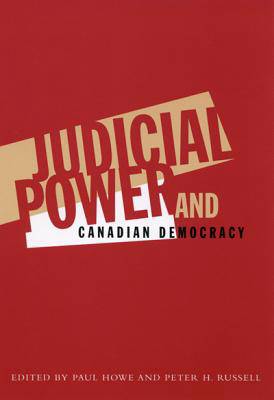
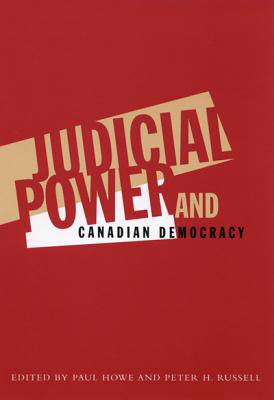
The role the courts should play in Canada's political system is a long-simmering issue. Ever since the Charter of Rights and Freedoms came into effect in 1982, Canada's courts have been empowered to strike down any legislation held to contravene Canadians' basic rights. While any number of court rulings since that time have caused a stir in legal and political circles, in the past several of years judicial decisions have attracted the attention of a broader public. Landmark rulings on a range of controversial issues, from aboriginal claims to gay rights, have captured the headlines and catalyzed public debate over the merits of judicial power. The controversy raises challenging questions about the role of a powerful judiciary in a democracy. In Judicial Power and Canadian Democracy, a series of essays commissioned by the Institute for Research on Public Policy, some of Canada's foremost commentators - academics, politicians, and Supreme Court judges themselves - take up the debate. Some tangle over the pivotal question: should judges have the decisive say on issues involving entrenched rights that have profound implication for the policy preferences of elected bodies? Others examine related issues, including Supreme Court appointment procedures, interest group litigation, the historical roots of the notwithstanding clause, and the state of public opinion on Canada's courts. Those interested in the power of the judicial branch will find much in this collection to stimulate fresh thinking on issues that are likely to remain on the public agenda for years to come. Contributors include Joseph F. Fletcher (Toronto), Janet Hiebert (Queen's), Gregory Hein (Toronto), Peter W. Hogg (York), Paul Howe, Rainer Knopff (Calgary), Sébastien Lebel-Grenier (Sherbrooke), Howard Leeson (Regina), Kate Malleson (London School of Economics), E. Preston Manning (Reform Party of Canada), Hon. Beverley McLachlin (Supreme Court of Canada), F.L. Morton (Calgary), Pierre Patenaude (Sherbrooke), Peter Russell, Allison A. Thornton (Blake, Cassels and Graydon), Frederick Vaughan (emeritus, Guelph), Lorraine Eisenstat Weinrib (Toronto), Hon. Bertha Wilson (emeritus, Supreme Court of Canada), and Jacob Ziegel (Toronto).
Spécifications
Parties prenantes
- Auteur(s) :
- Editeur:
Contenu
- Nombre de pages :
- 352
- Langue:
- Anglais
Caractéristiques
- EAN:
- 9780773522251
- Date de parution :
- 09-01-01
- Format:
- Livre broché
- Format numérique:
- Trade paperback (VS)
- Dimensions :
- 160 mm x 228 mm
- Poids :
- 512 g


Seulement chez Librairie Club
+ 103 points sur votre carte client de Librairie Club
Cadeau

Cadeau


Les avis
Nous publions uniquement les avis qui respectent les conditions requises. Consultez nos conditions pour les avis.