


- Retrait en 2 heures
- Assortiment impressionnant
- Paiement sécurisé
- Toujours un magasin près de chez vous
- Retrait en 2 heures
- Assortiment impressionnant
- Paiement sécurisé
- Toujours un magasin près de chez vous



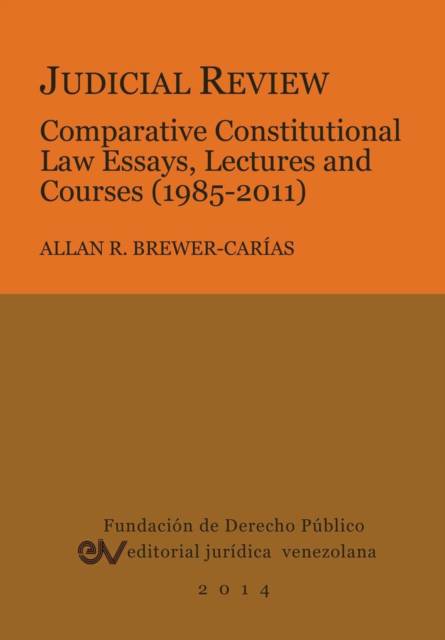
Judicial Review. Comparative Constitutional Law Essays, Lectures and Courses (1985-2011)
Allan R Brewer-Carias
Livre broché | Anglais
118,45 €
+ 236 points
Description
This book deals with Judicial Review, as the power of judges to control the constitutionality of State acts, particularly of Legislation, which not only is the most important subject of contemporary constitutional law, but also the most distinctive feature of all democratic constitutional systems. Such power is the consequence of the consolidation in contemporary constitutionalism of three fundamental principles of law: first, the existence of a written constitution or of a fundamental law, conceived as a superior law with clear supremacy over all other statutes; second, the "rigid" character of such constitution, which implies that the amendments or reforms that may be introduced can only be put into practice by means of a particular and special constituent process, preventing the ordinary legislator from doing so; and third, the establishment in that same written and rigid constitution or fundamental law, of the judicial means for guaranteeing its supremacy, over all other state acts, including legislative acts. According to such principles, consequently, in democratic systems subjected to the rule of law, the judges can have the power to refuse to enforce a statute when they deem it to be contrary to the Constitution, considering it null or void with inter partes effects, through what is known as the "American model" or the diffuse system of judicial review; or one particular Constitutional Court or the Supreme Court of the country can be empowered to annul laws considered unconstitutional, with erga omnes effects, through what is known as the " European model" or concentrated system of judicial review; with the possibility for both system to coexist, through what is known as the " Latin American model" or the mixed system of judicial review. These systems are analyzed in this book from a comparative constitutional law perspective, a matter that professor Brewer-Carias has been studying for the past decades, and on which he has extensively published in books and articles, in Spanish, French and English. But in addition, he has written many works and essays in English, that have not been published up to now, in particular for the preparation of Courses and Lectures he has given as was the case of the Course of Lectures on "Judicial Review in Comparative Law," he gave in the LL.M. Course at the Faculty of Law, University of Cambridge, UK., in 1985-1986; and the Lectures he gave on "Judicial Protection of Human Rights in Latin America. A Comparative Constitutional Law Study on the Latin American Injunction for the protection of Constitutional Rights ("Amparo proceeding")," at Columbia Law School in the City of New York, in 2006-2008. The original versions of these Lectures are published in this book, altogether with many other Papers, Reports and Lectures he has given in the past years in various Universities in the United States, analyzing from a comparative constitutional Law perspective, the systems of judicial review in the world, and in particular, in Latin America. The decision to publish this book with the recollection of the original versions of all those works, as the author has pointed out, has the purpose to assure that all those materials won't be lost, and could be useful for all those who have interest in these matters; being what they are: the written work of a law professor, made as a consequence of his research for the preparation of his lectures, not pretending to be anything else.
Spécifications
Parties prenantes
- Auteur(s) :
- Editeur:
Contenu
- Nombre de pages :
- 1198
- Langue:
- Anglais
Caractéristiques
- EAN:
- 9789803652128
- Date de parution :
- 30-01-14
- Format:
- Livre broché
- Format numérique:
- Trade paperback (VS)
- Dimensions :
- 170 mm x 244 mm
- Poids :
- 1859 g


Seulement chez Librairie Club
+ 236 points sur votre carte client de Librairie Club
Cadeau


Les avis
Nous publions uniquement les avis qui respectent les conditions requises. Consultez nos conditions pour les avis.