


- Retrait en 2 heures
- Assortiment impressionnant
- Paiement sécurisé
- Toujours un magasin près de chez vous
- Retrait gratuit dans votre magasin Club
- 7.000.0000 titres dans notre catalogue
- Payer en toute sécurité
- Toujours un magasin près de chez vous



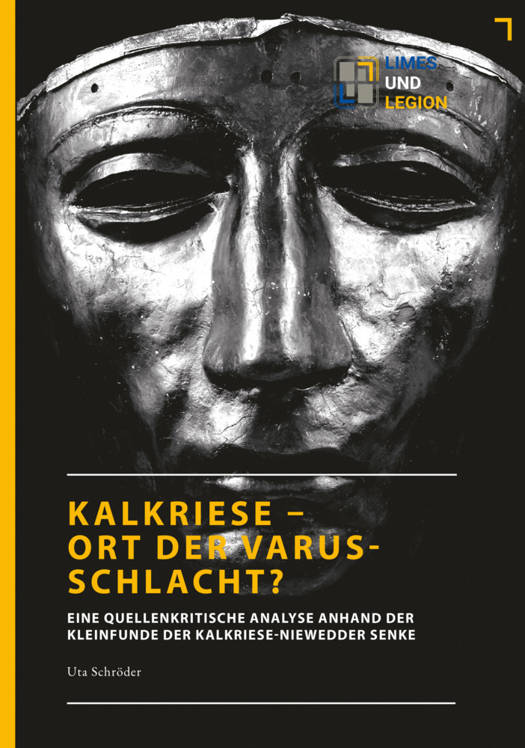
Kalkriese - Ort der Varusschlacht?
Eine quellenkritische Analyse anhand der Kleinfunde der Kalkriese-Niewedder Senke
Uta Schröder
93,95 €
+ 187 points
Description
Kalkriese - a battlefield that changed Europe. A site that still raises questions. A study that provides new answers.
For decades, the early Roman site of Kalkriese in the Osnabrück region has fascinated scholars like few other places. It is widely believed to be the site of the legendary Battle of the Teutoburg Forest in AD 9, in which the Germanic tribes achieved a decisive victory over the Roman army. A closer examination, however, reveals a highly complex interplay of archaeological and historical evidence that has so far prevented a definitive assessment of the site. What truly happened in this landscape in the early first century AD? Which Roman troops fought here - and against whom? And how reliable is what we believe we know?
This groundbreaking study by Uta Schröder, originally submitted as a doctoral dissertation at Ludwig Maximilian University of Munich, for the first time presents a comprehensive and critical synthesis of approximately 5,400 Early Imperial small finds, including more than 1,100 objects previously unpublished. In doing so, the work addresses a long-standing research gap. Through meticulous analysis, the author examines the dating, function, and spatial distribution of the artefacts, opening up a new and previously unavailable perspective on the chronology and character of the site.
The analysis leads to a key conclusion: a battle involving Roman infantry and cavalry units in the late Augustan-Tiberian period can be demonstrated beyond doubt. At the same time, the study reveals the extent to which agricultural activity, the selection of excavation areas, and uneven survey strategies have distorted previous interpretations of the site. Many long-held assumptions are called into question - from the concept of a fixed "Kalkriese horizon" to reconstructions of the actual course of the fighting.
This volume presents Kalkriese as one of the most significant, yet methodologically challenging archaeological sites of the Roman Empire in Europe. It clearly outlines the current state of research, identifies interpretative pitfalls that must be corrected, and highlights the immense potential for future investigations.
A seminal work for archaeology, ancient history, and for all those who seek to understand how scientific inquiry transforms material remains into historical knowledge - and how much history still lies hidden in the soil.
For decades, the early Roman site of Kalkriese in the Osnabrück region has fascinated scholars like few other places. It is widely believed to be the site of the legendary Battle of the Teutoburg Forest in AD 9, in which the Germanic tribes achieved a decisive victory over the Roman army. A closer examination, however, reveals a highly complex interplay of archaeological and historical evidence that has so far prevented a definitive assessment of the site. What truly happened in this landscape in the early first century AD? Which Roman troops fought here - and against whom? And how reliable is what we believe we know?
This groundbreaking study by Uta Schröder, originally submitted as a doctoral dissertation at Ludwig Maximilian University of Munich, for the first time presents a comprehensive and critical synthesis of approximately 5,400 Early Imperial small finds, including more than 1,100 objects previously unpublished. In doing so, the work addresses a long-standing research gap. Through meticulous analysis, the author examines the dating, function, and spatial distribution of the artefacts, opening up a new and previously unavailable perspective on the chronology and character of the site.
The analysis leads to a key conclusion: a battle involving Roman infantry and cavalry units in the late Augustan-Tiberian period can be demonstrated beyond doubt. At the same time, the study reveals the extent to which agricultural activity, the selection of excavation areas, and uneven survey strategies have distorted previous interpretations of the site. Many long-held assumptions are called into question - from the concept of a fixed "Kalkriese horizon" to reconstructions of the actual course of the fighting.
This volume presents Kalkriese as one of the most significant, yet methodologically challenging archaeological sites of the Roman Empire in Europe. It clearly outlines the current state of research, identifies interpretative pitfalls that must be corrected, and highlights the immense potential for future investigations.
A seminal work for archaeology, ancient history, and for all those who seek to understand how scientific inquiry transforms material remains into historical knowledge - and how much history still lies hidden in the soil.
Spécifications
Parties prenantes
- Auteur(s) :
- Editeur:
Contenu
- Langue:
- Allemand
- Collection :
Caractéristiques
- EAN:
- 9783752009408
- Format:
- Livre relié
- Dimensions :
- 210 mm x 297 mm
- Poids :
- 1805 g


Seulement chez Librairie Club
+ 187 points sur votre carte client de Librairie Club

Les avis
Nous publions uniquement les avis qui respectent les conditions requises. Consultez nos conditions pour les avis.