


- Retrait en 2 heures
- Assortiment impressionnant
- Paiement sécurisé
- Toujours un magasin près de chez vous
- Retrait en 2 heures
- Assortiment impressionnant
- Paiement sécurisé
- Toujours un magasin près de chez vous



7,99 €
+ 7 points
Format
Description
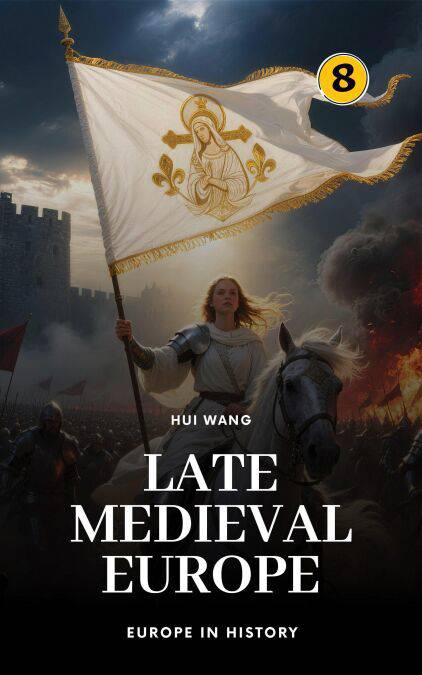
Late Medieval Europe: Europe in History, PART TWO, invites you to walk alongside the people who made their age restless — King John wrestling with his barons over the Magna Carta (1215 CE), Pope Boniface VIII locking horns with monarchs and suffering the Outrage of Anagni (1303 CE), and William of Ockham probing the very nature of truth and authority. This section of the journey moves through the clashes between crown and church, faith and power, showing how rulers such as Philip IV of France (r. 1285–1314 CE) forced Europe to rethink who should hold ultimate authority long before the modern era arrived.
From there the story turns to the chaos of divided faith. The Western Schism (1378–1417 CE) rends Christendom as rival popes vie for allegiance, and Emperor Sigismund steps onto the stage at the Council of Constance (1414–1418 CE) to try to heal a fractured church. These chapters follow the drama of councils, negotiations, and relentless political maneuvering, revealing how figures from Boniface VIII through to Sigismund — and the reforming thinkers who reacted to them — helped shape a Europe still searching for unity.
War and ambition carry us across the Channel into the long, grinding contest between England and France. Edward III's early triumphs on the battlefield set a tone of pride and possibility for England; the later troubles of Richard II, and the strains within the Plantagenet dynasty, leave a kingdom pushed to its limits and looking for new claimants and new conflicts.
France, meanwhile, suffers its own ruptures. The Valois kings — beginning with Philip VI — confront political fractures that deepen under the mentally ill Charles VI, whose incapacity fuels factional rivalry and civil war. Out of that chaos a young woman, Joan of Arc, will rise as a startling emblem of faith and defiance: her leadership rallies French forces, crowns a king in Charles VII, and alters the course of the struggle in ways few had expected.
But these centuries are about more than crowns and battlefields. In the Holy Roman Empire, the balance of power is a constant negotiation — electors and emperors bargaining, scheming, and jockeying for authority across a patchwork of principalities. And in Italy, new voices begin to be heard: Petrarch and a growing circle of merchant humanists reshape how people read, write, and value the past. As literacy spreads beyond cloistered elites, merchants, scholars, and rulers together lay the groundwork for a new intellectual world.
I wrote this book to weave a cast of extraordinary figures — John, Philip IV, Edward III, Sigismund, Petrarch, Joan of Arc, and many others — into a single, continuous narrative that reads vivid and human. Late Medieval Europe: Europe in History is not simply a chronicle of what happened; it is an attempt to explain why the Middle Ages did not vanish overnight and how their aftershocks still shape our political fights, cultural arguments, and the ways we imagine ourselves today. These are not distant, dusty characters in a museum case but living presences whose choices, failures, and stubborn ideals continue to reverberate through our institutions and identities.
Spécifications
Parties prenantes
- Auteur(s) :
- Editeur:
Contenu
- Langue:
- Anglais
- Collection :
Caractéristiques
- EAN:
- 9789190150269
- Date de parution :
- 17-02-26
- Format:
- Ebook
- Protection digitale:
- /
- Format numérique:
- ePub


Seulement chez Librairie Club
+ 7 points sur votre carte client de Librairie Club
Cadeau


Les avis
Nous publions uniquement les avis qui respectent les conditions requises. Consultez nos conditions pour les avis.