


- Retrait en 2 heures
- Assortiment impressionnant
- Paiement sécurisé
- Toujours un magasin près de chez vous
- Retrait en 2 heures
- Assortiment impressionnant
- Paiement sécurisé
- Toujours un magasin près de chez vous



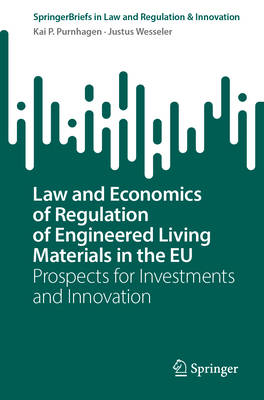
Law and Economics of Regulation of Engineered Living Materials in the EU
Prospects for Investments and Innovation
Kai P Purnhagen, Justus Wesseler
48,45 €
+ 96 points
Description
Engineered Living Materials (ELMs) have emerged as one of the most promising and conceptually disruptive technological developments at the intersection of biotechnology, materials science, and engineering. Over the past decade, they have attracted growing attention from researchers, policymakers, and funding bodies, culminating in high-profile recognition such as recognition among the Top 10 Emerging Technologies of 2025 by the World Economic Forum by the OECD in its forecasting as a foundational technological development that will reach maturity in the next 5-10 years. Within the European Union, the European Innovation Council has explicitly identified ELMs as a strategic priority, supporting their development through targeted funding initiatives aimed at positioning Europe at the forefront of this still-nascent technological domain. At the same time, ELMs challenge the conceptual and institutional foundations of existing regulatory frameworks. By integrating living cells into functional materials, ELMs blur traditional distinctions between products and processes, organisms and objects, and biological and industrial systems. Many ELMs rely on genetic engineering, often through new genomic techniques such as CRISPR-based mutagenesis, placing them squarely within the scope of European Union legislation governing genetically modified organisms (GMOs) and genetically modified microorganisms (GMMs). These regulatory regimes, however, were largely designed in the late 1990s and early 2000s with agricultural biotechnology and food safety in mind. The central question addressed in this study is therefore whether the current EU regulatory framework is capable of accommodating ELMs in a way that ensures safety while also fostering innovation and investment. The book adopts an interdisciplinary methodology to assess how this regulatory framework interacts with the development of ELMs. Doctrinal legal analysis is used to map the scope, structure, and internal logic of EU legislation governing GMOs, GMMs, food law, medicinal products, and environmental release. This is complemented by an economic analysis based on real options theory, which examines how regulatory uncertainty, approval delays, and compliance costs affect incentives to invest in ELM-related innovation. By combining these approaches, the authors aim to move beyond abstract legal interpretation and to assess how regulation operates in action, particularly from the perspective of innovators and investors.
Spécifications
Parties prenantes
- Auteur(s) :
- Editeur:
Contenu
- Nombre de pages :
- 73
- Langue:
- Anglais
- Collection :
Caractéristiques
- EAN:
- 9783032225320
- Date de parution :
- 14-07-26
- Format:
- Livre broché
- Format numérique:
- Trade paperback (VS)
- Dimensions :
- 155 mm x 235 mm


Seulement chez Librairie Club
+ 96 points sur votre carte client de Librairie Club
Cadeau


Les avis
Nous publions uniquement les avis qui respectent les conditions requises. Consultez nos conditions pour les avis.