


- Retrait en 2 heures
- Assortiment impressionnant
- Paiement sécurisé
- Toujours un magasin près de chez vous
- Retrait en 2 heures
- Assortiment impressionnant
- Paiement sécurisé
- Toujours un magasin près de chez vous



58,00 €
+ 116 points
Description
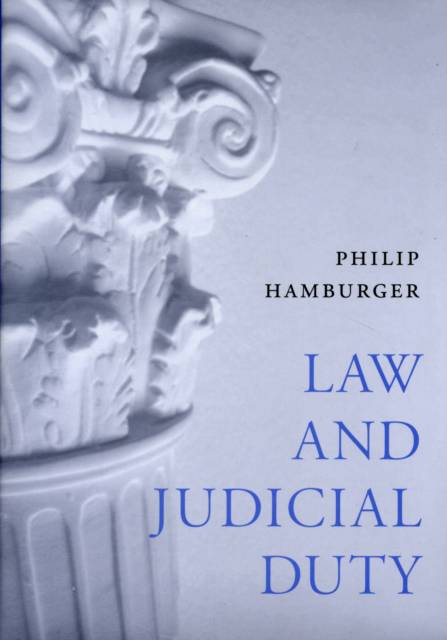
Philip Hamburger's Law and Judicial Duty traces the early history of what is today called "judicial review." Working from previously unexplored evidence, Hamburger questions the very concept of judicial review. Although decisions holding statutes unconstitutional are these days considered instances of a distinct judicial power of review, Hamburger shows that they were once understood merely as instances of a broader judicial duty. The book's focus on judicial duty overturns the familiar debate about judicial power. The book is therefore essential reading for anyone concerned about the proper role of the judiciary. Hamburger lays the foundation for his argument by explaining the common law ideals of law and judicial duty. He shows that the law of the land was understood to rest on the authority of the lawmaker and that what could not be discerned within the law of the land was not considered legally binding. He then shows that judges had a duty to decide in accord with the law of the land. These two ideals--law and judicial duty--together established and limited what judges could do. By reviving an understanding of these common law ideals, Law and Judicial Duty calls into question the modern assumption that judicial review is a power within the judges' control. Indeed, the book shows that what is currently considered a distinct power of review was once understood as a matter of duty--the duty of judges to decide in accord with the law of the land. The book thereby challenges the very notion of judicial review. It shows that judges had authority to hold government acts unconstitutional, but that they enjoyed this power only to the extent it was required by their duty. In laying out the common law ideals, and in explaining judicial review as an aspect of judicial duty, Law and Judicial Duty reveals a very different paradigm of law and of judging than prevails today. The book, moreover, sheds new light on a host of misunderstood problems, including intent, manifest contradiction, the status of foreign and international law, the cases and controversies requirement, and the authority of judicial precedent.
Spécifications
Parties prenantes
- Auteur(s) :
- Editeur:
Contenu
- Nombre de pages :
- 704
- Langue:
- Anglais
Caractéristiques
- EAN:
- 9780674031319
- Date de parution :
- 01-11-08
- Format:
- Livre relié
- Format numérique:
- Ongenaaid / garenloos gebonden
- Dimensions :
- 163 mm x 231 mm
- Poids :
- 1065 g



Seulement chez Librairie Club
+ 116 points sur votre carte client de Librairie Club
Cadeau


Les avis
Nous publions uniquement les avis qui respectent les conditions requises. Consultez nos conditions pour les avis.