


- Retrait en 2 heures
- Assortiment impressionnant
- Paiement sécurisé
- Toujours un magasin près de chez vous
- Retrait en 2 heures
- Assortiment impressionnant
- Paiement sécurisé
- Toujours un magasin près de chez vous



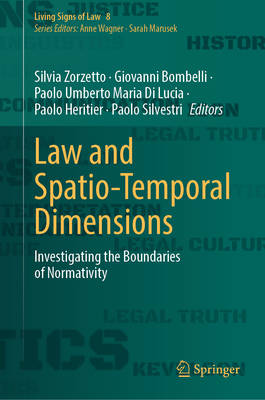
Law and Spatio-Temporal Dimensions
Investigating the Boundaries of Normativity
194,95 €
+ 389 points
Description
This book provides a multifaceted investigation into the relationship between law, normativity, and the spatio-temporal coordinates in which legal phenomena emerge and transform. It offers a cross-disciplinary and philosophically grounded perspective that rethinks the categories of space and time as fundamental dimensions of the normative experience. Bringing together contributions from legal theory, philosophy, semiotics, comparative law, and cultural studies, the volume explores how law is affected by, and in turn affects, evolving conceptions of time and space and how the legal experience belongs to human history. This book investigates the ontological status of legal norms and the implications of their despatialisation or deterritorialisation in digital and transnational contexts. Several chapters address questions about the existence and longevity of legal norms, others examine the distinction between the spatial scope and the actual validity of norms in light of the effects of political change, cyber-activities, and global regulatory trends. The temporal dimension of legal responsibility is re-examined with regard to concepts such as negligence, intention, and agency.
Moreover, the book explores challenges of decision-making posed by algorithmic governance and behavioural regulation involving classical models of normativity based on rationality and chronological linearity. Furthermore, the volume draws on intellectual traditions from across the world (Western phenomenology, classical legal thought, non-Western cosmologies and ethical frameworks) for reconsidering the way normativity is shaped by paradigms of space and time related to peculiar dimensions (rhythm, ritual, kairos), which offer alternative temporalities encompassing legal practices and our understanding of some philosophical-legal categories. By integrating legal philosophy with intercultural and technological-ecological perspectives, this book opens new avenues for understanding law s dynamic entanglement with space and time.
This volume is intended for scholars and advanced students in legal philosophy, jurisprudence, legal semiotics, comparative law, and interdisciplinary legal studies interested in exploring emerging paradigms of normativity beyond traditional legal frameworks.
Spécifications
Parties prenantes
- Editeur:
Contenu
- Nombre de pages :
- 335
- Langue:
- Anglais
- Collection :
- Tome:
- n° 8
Caractéristiques
- EAN:
- 9783032254290
- Date de parution :
- 20-07-26
- Format:
- Livre relié
- Format numérique:
- Genaaid
- Dimensions :
- 155 mm x 235 mm

Seulement chez Librairie Club
+ 389 points sur votre carte client de Librairie Club
Cadeau


Les avis
Nous publions uniquement les avis qui respectent les conditions requises. Consultez nos conditions pour les avis.