Club utilise des cookies et des technologies similaires pour faire fonctionner correctement le site web et vous fournir une meilleure expérience de navigation.
Ci-dessous vous pouvez choisir quels cookies vous souhaitez modifier :
Club utilise des cookies et des technologies similaires pour faire fonctionner correctement le site web et vous fournir une meilleure expérience de navigation.
Nous utilisons des cookies dans le but suivant :
Assurer le bon fonctionnement du site web, améliorer la sécurité et prévenir la fraude
Avoir un aperçu de l'utilisation du site web, afin d'améliorer son contenu et ses fonctionnalités
Pouvoir vous montrer les publicités les plus pertinentes sur des plateformes externes
Club utilise des cookies et des technologies similaires pour faire fonctionner correctement le site web et vous fournir une meilleure expérience de navigation.
Ci-dessous vous pouvez choisir quels cookies vous souhaitez modifier :
Cookies techniques et fonctionnels
Ces cookies sont indispensables au bon fonctionnement du site internet et vous permettent par exemple de vous connecter. Vous ne pouvez pas désactiver ces cookies.
Cookies analytiques
Ces cookies collectent des informations anonymes sur l'utilisation de notre site web. De cette façon, nous pouvons mieux adapter le site web aux besoins des utilisateurs.
Cookies marketing
Ces cookies partagent votre comportement sur notre site web avec des parties externes, afin que vous puissiez voir des publicités plus pertinentes de Club sur des plateformes externes.
Une erreur est survenue, veuillez réessayer plus tard.
Il y a trop d’articles dans votre panier
Vous pouvez encoder maximum 250 articles dans votre panier en une fois. Supprimez certains articles de votre panier ou divisez votre commande en plusieurs commandes.
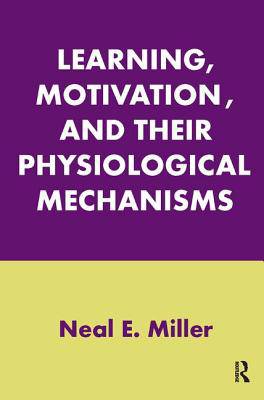
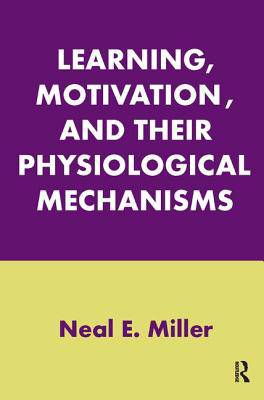
Neal E. Miller's pioneering work in experimental psychology has earned him worldwide respect. This second in a two-volume collection of his work brings together forty-three of Miller's most important and representative essays on learning, motivation, and their physiological mechanisms. They were selected on the basis of their current relevance and their historical significance at the time they were published. In order to emphasize the main themes, essays on a given topic have been grouped together.Learning, Motivation, and Their Physiological Mechanisms begins when the author first discovered the thrill of designing and executing experiments to get clear-cut answers concerning the behavior of children and of rats. The first study was one of the earliest ones on the behavioral effects of the recently synthesized male hormone, testosterone. The second was one of the earliest studies demonstrating the value of using a variety of behavioral techniques to investigate the motivational effects of a physiological intervention. The next studies investigated the satisfying and rewarding effects of food or water in the stomach versus in the mouth and the thirst-inducing and reducing effects of hyper- and hypotonic solutions, respectively, injected into the brain. The last study describes a technique devised for extending the analysis of the mechanism of hunger to the effects of humoral factors in the blood.The study is completed with an examination of trial-and-error learning that was motivated by direct electrical stimulation of the brain and rewarded by the termination of such stimulation. Other studies show that the stimulation via such electrodes not only elicits eating, but also has the principal motivational characteristics of normal hunger. The conclusion deals with a series of experiments that overthrows strong traditional beliefs by proving that glandular and visceral responses mediated by the autonomic nervous system are subject to instrumental learning, which can be made quite specific.