


En raison d'une grève chez bpost, des retards de livraison peuvent survenir. Besoin de quelque chose en urgence ? Optez pour un retrait en magasin ou rendez-vous dans une Librairie Club à proximité.
- Retrait en 2 heures
- Assortiment impressionnant
- Paiement sécurisé
- Toujours un magasin près de chez vous
En raison d'une grève chez bpost, des retards de livraison peuvent survenir. Besoin de quelque chose en urgence ? Optez pour un retrait en magasin ou rendez-vous dans une Librairie Club à proximité.
- Retrait en 2 heures
- Assortiment impressionnant
- Paiement sécurisé
- Toujours un magasin près de chez vous



32,95 €
+ 65 points
Description
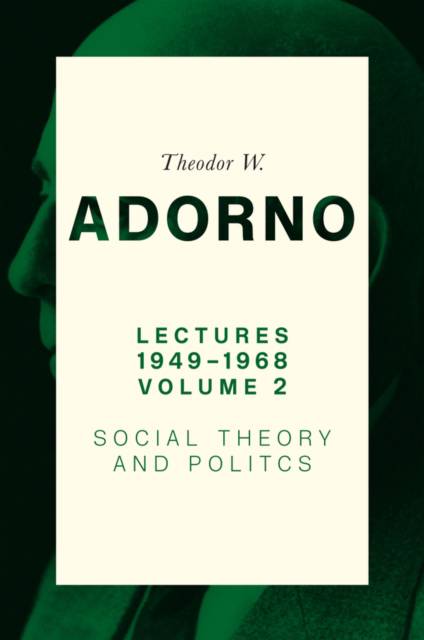
When Theodor W. Adorno returned to Germany from his exile in the United States, he was appointed as a lecturer and researcher at the University of Frankfurt and he immediately made a name for himself as a leading public intellectual. Adorno's widespread influence on the postwar debates was due in part to the public lectures he gave outside of the university in which he analysed and commented on social, cultural and political developments of the time.
This second volume brings together Adorno's lectures given between 1949 and 1968 on social and political themes. With an engaging and improvisational style, Adorno spoke with infectious vigour about architecture and city planning, the relationship between the individual and society, the authoritarian personality and far-right extremism, political education and the current state of sociology, among other subjects. After Auschwitz, it was incumbent on Germany to undertake intensive memory work and to confront the reality of its own moral destruction, while rebuilding its political and economic systems. To rebuild was taken to mean rediscovery and looking outward, but Adorno also nurtured a vision of tradition which - far from being unthinkingly conservative - would attest to society's honestly-appraised relationship to the past while it underwent the process of modernization. The volume illustrates Adorno's deep commitment to holding society to standards commensurate with the aspirations of a modern world emerging from the horrors of war.
This volume of his lectures is a unique document of Adorno's startling ability to bring critical theory into dialogue with the times in which he lived. It will be of great value to anyone interested in the work of Adorno and critical theory, in German intellectual and cultural history and in sociology and politics.
This second volume brings together Adorno's lectures given between 1949 and 1968 on social and political themes. With an engaging and improvisational style, Adorno spoke with infectious vigour about architecture and city planning, the relationship between the individual and society, the authoritarian personality and far-right extremism, political education and the current state of sociology, among other subjects. After Auschwitz, it was incumbent on Germany to undertake intensive memory work and to confront the reality of its own moral destruction, while rebuilding its political and economic systems. To rebuild was taken to mean rediscovery and looking outward, but Adorno also nurtured a vision of tradition which - far from being unthinkingly conservative - would attest to society's honestly-appraised relationship to the past while it underwent the process of modernization. The volume illustrates Adorno's deep commitment to holding society to standards commensurate with the aspirations of a modern world emerging from the horrors of war.
This volume of his lectures is a unique document of Adorno's startling ability to bring critical theory into dialogue with the times in which he lived. It will be of great value to anyone interested in the work of Adorno and critical theory, in German intellectual and cultural history and in sociology and politics.
Spécifications
Parties prenantes
- Auteur(s) :
- Traducteur(s):
- Editeur:
Contenu
- Nombre de pages :
- 264
- Langue:
- Anglais
Caractéristiques
- EAN:
- 9781509552429
- Date de parution :
- 19-02-25
- Format:
- Livre broché
- Format numérique:
- Trade paperback (VS)
- Dimensions :
- 155 mm x 227 mm
- Poids :
- 390 g



Seulement chez Librairie Club
+ 65 points sur votre carte client de Librairie Club
Cadeau


Les avis
Nous publions uniquement les avis qui respectent les conditions requises. Consultez nos conditions pour les avis.