


- Retrait en 2 heures
- Assortiment impressionnant
- Paiement sécurisé
- Toujours un magasin près de chez vous
- Retrait en 2 heures
- Assortiment impressionnant
- Paiement sécurisé
- Toujours un magasin près de chez vous



93,45 €
+ 186 points
Description
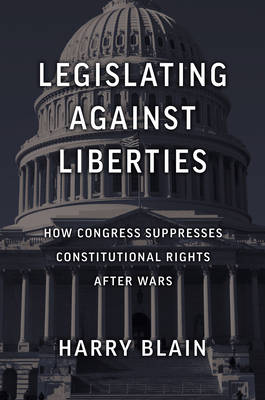
A sobering and eyeopening indictment that Congress has consistently been the most dangerous branch of government when it comes to protecting, and undermining, civil liberties--particularly in the wake of military conflict.
Why do wartime restrictions on civil liberties outlive their original justifications? Scholars have long argued that the blame lies with the executive branch of government. Their logic is straightforward: during war, lawmakers require (in Alexander Hamilton's words) "decision, activity, secrecy, and dispatch," so they choose to enable executive leadership. Executives promise to wield extraordinary powers temporarily, only to entrench them indefinitely. This book tests how these claims hold up in four pivotal moments in US history: the Civil War, World War I, World War II, and Vietnam. Ultimately, it finds them wanting.
Harry Blain argues that national legislators are decisive in sustaining postwar restrictions on civil liberties. These elected officials have formidable tools at their disposal, including powers over the rules and membership of their own institution, the funding and personnel of the executive branch, the jurisdiction of federal courts, and the priorities of state and local governments. These tools make Congress, not the executive, the primary institutional threat to civil liberties in the aftermath of war. For example, the House used its exclusion power to refuse to seat the socialist Victor Berger, disenfranchising voters in the process; Congress used its power to compel testimony during the Red Scares in an effort to discredit and humiliate their political enemies; and legislators have removed, or threatened to remove, Supreme Court jurisdiction over habeas corpus petitions throughout US history.
In a time where the president and the Supreme Court are seen as the most dangerous branches of government, Legislating Against Liberties is a sober reminder that Congress has historically been at the vanguard of undermining democracy and liberty.
Spécifications
Parties prenantes
- Auteur(s) :
- Editeur:
Contenu
- Nombre de pages :
- 272
- Langue:
- Anglais
- Collection :
Caractéristiques
- EAN:
- 9780700641055
- Date de parution :
- 31-03-26
- Format:
- Livre relié
- Format numérique:
- Genaaid
- Dimensions :
- 152 mm x 229 mm
- Poids :
- 539 g


Seulement chez Librairie Club
+ 186 points sur votre carte client de Librairie Club
Cadeau


Les avis
Nous publions uniquement les avis qui respectent les conditions requises. Consultez nos conditions pour les avis.