


- Retrait en 2 heures
- Assortiment impressionnant
- Paiement sécurisé
- Toujours un magasin près de chez vous
- Retrait en 2 heures
- Assortiment impressionnant
- Paiement sécurisé
- Toujours un magasin près de chez vous



29,95 €
+ 59 points
Description
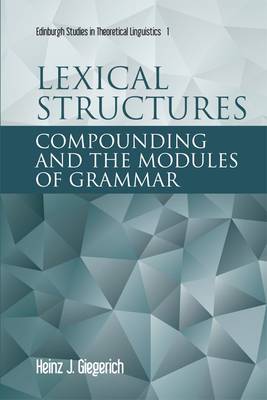
An original study of both structural entities originating in the lexicon, and the structural characteristics of the lexicon as a module of formal grammar, this book makes two contributions to our understanding of the formal grammar of English. Firstly, it presents a coherent theory of 'compounding' in English. There is a long-standing but unresolved dispute in the literature as to whether certain constructions (e.g. LONDON ROAD, DENTAL TREATMENT) are compound words or syntactic phrases. The question is important because in other cases the distinction is clear-cut (RING ROAD, FREE TREATMENT respectively), and because it impinges on central assumptions regarding the organisation of the grammar.Secondly, the book suggests an alternative to the commonly assumed sharp division of the grammar into the 'lexicon' and the 'syntax'. The lexicon-syntax distinction facilitates important new insights in the nature of compounding in English. However, Heinz Giegerich argues that the Lexicalist assumption of a sharp divide between the modules cannot be upheld: the two modules overlap, such that there are constructions in English that are simultaneously compound and phrase. He suggests an alternative, tripartite, structure comprising three successive, and significantly overlapping, modules: the lexicon proper, the morphology and the syntax.The book illustrates a grammar that is rather different from that envisaged in Lexicalism (while still retaining that theory's basic insights) and provides a better understanding of some of the most recalcitrant problems in English word formation.
Spécifications
Parties prenantes
- Auteur(s) :
- Editeur:
Contenu
- Nombre de pages :
- 152
- Langue:
- Anglais
- Collection :
Caractéristiques
- EAN:
- 9781399572651
- Date de parution :
- 30-11-26
- Format:
- Livre broché
- Format numérique:
- Trade paperback (VS)
- Dimensions :
- 156 mm x 234 mm


Seulement chez Librairie Club
+ 59 points sur votre carte client de Librairie Club
Cadeau


Les avis
Nous publions uniquement les avis qui respectent les conditions requises. Consultez nos conditions pour les avis.