


En raison d'une grève chez bpost, des retards de livraison peuvent survenir. Besoin de quelque chose en urgence ? Optez pour un retrait en magasin ou rendez-vous dans une Librairie Club à proximité.
- Retrait en 2 heures
- Assortiment impressionnant
- Paiement sécurisé
- Toujours un magasin près de chez vous
En raison d'une grève chez bpost, des retards de livraison peuvent survenir. Besoin de quelque chose en urgence ? Optez pour un retrait en magasin ou rendez-vous dans une Librairie Club à proximité.
- Retrait en 2 heures
- Assortiment impressionnant
- Paiement sécurisé
- Toujours un magasin près de chez vous



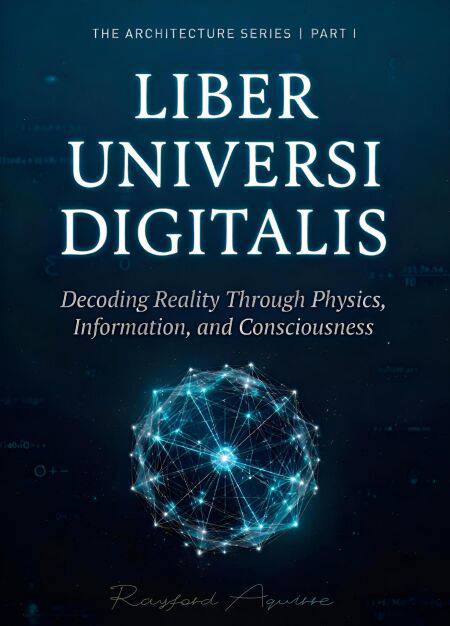
Description
What if reality is not made of things—but of information?
*Liber Universi Digitalis* is a work of philosophical non-fiction that explores one of the most profound questions of our time: how should we understand the universe in an age shaped by physics, computation, and artificial intelligence?
Blending scientific insight with conceptual clarity, this book examines:
* Quantum phenomena such as the double-slit experiment, entanglement, and decoherence
* The limits of physical reality, including the Planck scale, light speed, and entropy
* The possibility that spacetime itself may emerge from deeper informational structures
* The enduring mystery of consciousness and the "hard problem"
* The role of the observer in shaping how reality is described and experienced
* The implications of artificial intelligence and the ethics of creating mind-like systems
Using the language of code as a guiding metaphor, *Liber Universi Digitalis* offers a structured way to think about reality—not as a literal program, but as a system that can be described, modeled, and interpreted through information.
At the same time, the book carefully distinguishes between established science, theoretical interpretation, and philosophical speculation. It does not claim to prove that the universe is a simulation. Instead, it asks what becomes visible when we treat it as if it were structured like one.
This is a book for readers who are curious about the deep connections between physics, philosophy, and computation—and who are willing to explore the boundary where explanation ends and experience begins.
Clear, rigorous, and thought-provoking, *Liber Universi Digitalis* invites you to reconsider what it means to observe, to understand, and to exist.
The code may describe the structure.
But you are the one who experiences the result.
Spécifications
Parties prenantes
- Auteur(s) :
- Editeur:
Contenu
- Langue:
- Anglais
- Collection :
Caractéristiques
- EAN:
- 9798233382833
- Date de parution :
- 13-04-26
- Format:
- Ebook
- Protection digitale:
- /
- Format numérique:
- ePub


Seulement chez Librairie Club
Cadeau


Les avis
Nous publions uniquement les avis qui respectent les conditions requises. Consultez nos conditions pour les avis.