


- Retrait en 2 heures
- Assortiment impressionnant
- Paiement sécurisé
- Toujours un magasin près de chez vous
- Retrait gratuit dans votre magasin Club
- 7.000.0000 titres dans notre catalogue
- Payer en toute sécurité
- Toujours un magasin près de chez vous



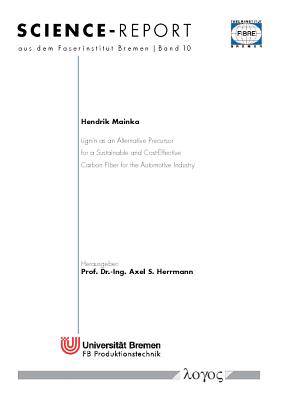
Lignin as an Alternative Precursor for a Sustainable and Cost-Effective Carbon Fiber for the Automotive Industry
Hendrik Mainka
Livre broché | Anglais
104,95 €
+ 209 points
Description
Lightweight construction is an integral part of the overall Volkswagen strategy for the reduction of CO2 emissions. A lower vehicle weight has a direct correlation to the reduction of the CO2 emissions. One potential way to reduce weight is the utilization of lightweight carbon fiber reinforced plastics (CFRP). The mass reduction leads to a significant saving of CO2 emissions. Currently the drawbacks of using CFRPs are the high manufacturing cost. The manufacturing cost of carbon fiber can be significantly reduced by the use of alternative precursors. The decision to use an alternative precursor to produce carbon fiber is based on the price, the availability, and the renewability of the precursor in question. Lignin is a natural waste byproduct of the paper industry, which is readily available in enormous amounts and due to this very inexpensive. Since lignin is a natural product it can have different properties depending on the plant in which it is derived from and the process in which it is isolated. To get a better understanding of lignin as a precursor for carbon fiber production, a systematical analysis of the properties, compounding, and chemical structure is made. To investigate the potential of lignin as an alternative precursor a set of fundamental production steps were needed to be established, to produce carbon fiber from lignin. These steps consist of: pelletizing, fiber spinning, fiber stabilization, and carbonization. The intermediate products of these steps are the lignin powder, the lignin pellets, the lignin fiber as well as the oxidized and carbonized lignin fiber. At each step the properties and chemical structure were analyzed. This dissertation shows the complete production process of carbon fiber made from lignin by analyzing the chemical structure of all intermediate products, and determines the potential of lignin as an alternative, economic and ecological precursor.
Spécifications
Parties prenantes
- Auteur(s) :
- Editeur:
Contenu
- Nombre de pages :
- 200
- Langue:
- Anglais
Caractéristiques
- EAN:
- 9783832539726
- Date de parution :
- 20-05-15
- Format:
- Livre broché
- Format numérique:
- Trade paperback (VS)
- Dimensions :
- 145 mm x 211 mm
- Poids :
- 1614 g


Seulement chez Librairie Club
+ 209 points sur votre carte client de Librairie Club

Les avis
Nous publions uniquement les avis qui respectent les conditions requises. Consultez nos conditions pour les avis.