


- Retrait en 2 heures
- Assortiment impressionnant
- Paiement sécurisé
- Toujours un magasin près de chez vous
- Retrait gratuit dans votre magasin Club
- 7.000.0000 titres dans notre catalogue
- Payer en toute sécurité
- Toujours un magasin près de chez vous


Description
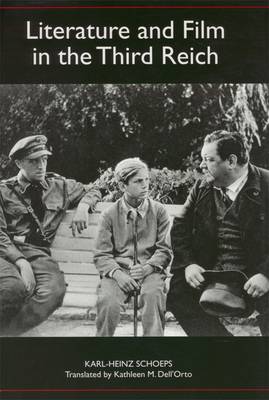
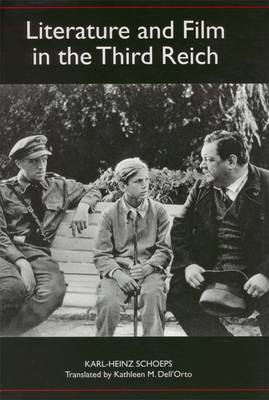
This volume is the first survey in English of literature and film in Nazi Germany. It treats not only works sympathetic to National Socialism, but also works of the so-called Inner Emigration, of the resistance, and those written in prisons and concentration camps. Much of this literature is not easily accessible in German, and not available at all in English translation. Historical and ideological context is provided in chapters covering influential works of the time such as Alfred Rosenberg's The Myth of the Twentieth Century and Houston Stewart Chamberlain's The Foundations of the Nineteenth Century. Schoeps also analyzes Nazi cultural policies, fascist histories of literature, and the role of German studies and Germanists in the Nazi movement. A major section of the book is devoted to film, then a relatively new medium of communication whose propaganda value was clearly recognized by Goebbels, the minister for propaganda and president of the Reich's Chamber of Culture. This book is based on the revised and expanded second German edition, Literatur im Dritten Reich (1933-1945), but has again been revised and expanded, especially the chapter on film and Nazi policies toward the film industry. The chapter on cultural policies has also been expanded to include Himmler's efforts to meddle in this area. New are also sections dealing with Jewish entertainers in concentration camps (for example, Kurt Gerron) and activities of the Jewish Cultural League. One of the most interesting areas of research in recent years is the relationship between Hitler's cultural commissars, in particular Goebbels, and the literature and film production of the Nazi years. For at least twenty years after the end of the Second World War, it was difficult to obtain copies of films made during the twelve-year-long Third Reich. An additional hindrance to research in this area was the understandable reluctance of many scholars to analyze the literary and cinematic productions of such a discredited regime. With the fall of the wall, the development of new video technologies, and the emergence of ever-greater interest in film and in the cultural policies of Nazi Germany, scholars are in a far better position to analyze the productions of that period -- a position that Schoeps's book fully exploits. Karl-Heinz Schoeps is Emeritus Professor of German at the University of Illinois at Urbana-Champaign.
Spécifications
Parties prenantes
- Auteur(s) :
- Traducteur(s):
- Editeur:
Contenu
- Nombre de pages :
- 382
- Langue:
- Anglais
- Collection :
- Tome:
- n° 85
Caractéristiques
- EAN:
- 9781571134721
- Date de parution :
- 01-09-10
- Format:
- Livre broché
- Format numérique:
- Trade paperback (VS)
- Dimensions :
- 152 mm x 229 mm
- Poids :
- 512 g


Seulement chez Librairie Club
+ 128 points sur votre carte client de Librairie Club
Cadeau

Cadeau


Les avis
Nous publions uniquement les avis qui respectent les conditions requises. Consultez nos conditions pour les avis.