


- Retrait en 2 heures
- Assortiment impressionnant
- Paiement sécurisé
- Toujours un magasin près de chez vous
- Retrait gratuit dans votre magasin Club
- 7.000.0000 titres dans notre catalogue
- Payer en toute sécurité
- Toujours un magasin près de chez vous



Description
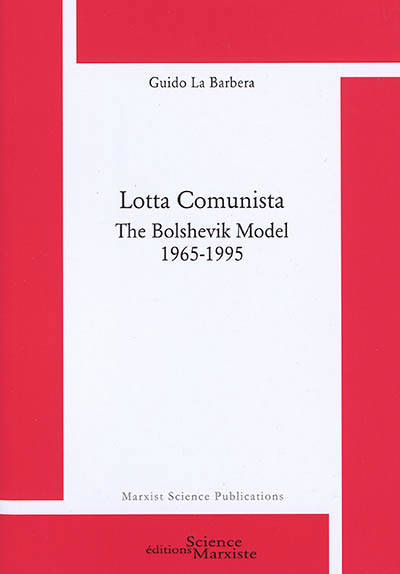
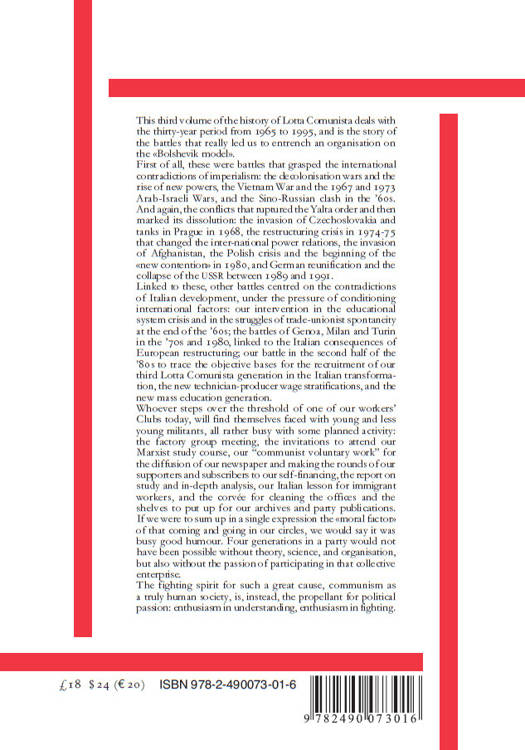
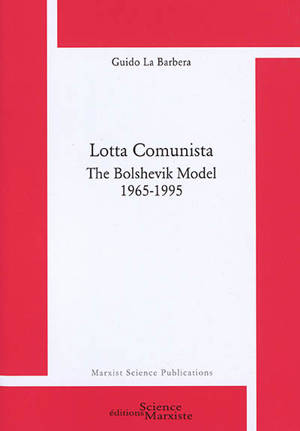
This third volume of the history of Lotta Comunista deals with the thirty-year period from 1965 to 1995, and is the story of the battles that really led us to entrench an organisation on the «Bolshevik model».
First of all, these were battles that grasped the international contradictions of imperialism: the decolonisation wars and the rise of new powers, the Vietnam War and the 1967 and 1973 Arab-Israeli Wars, and the Sino-Russian clash in the ’60s. And again, the conflicts that ruptured the Yalta order and then marked its dissolution: the invasion of Czechoslovakia and tanks in Prague in 1968, the restructuring crisis in 1974-75 that changed the inter-national power relations, the invasion of Afghanistan, the Polish crisis and the beginning of the «new contention» in 1980, and German reunification and the collapse of the USSR between 1989 and 1991.
Linked to these, other battles centred on the contradictions of Italian development, under the pressure of conditioning international factors: our intervention in the educational system crisis and in the struggles of trade-unionist spontaneity at the end of the ’60s; the battles of Genoa, Milan and Turin in the ’70s and 1980, linked to the Italian consequences of European restructuring; our battle in the second half of the ’80s to trace the objective bases for the recruitment of our third Lotta Comunista generation in the Italian transforma-tion, the new technician-producer wage stratifications, and the new mass education generation.
Whoever steps over the threshold of one of our workers’ Clubs today, will find themselves faced with young and less young militants, all rather busy with some planned activity: the factory group meeting, the invitations to attend our Marxist study course, our “communist voluntary work” for
the diffusion of our newspaper and making the rounds of our supporters and subscribers to our self-financing, the report on study and in-depth analysis, our Italian lesson for immigrant workers, and the corvée for cleaning the offices and the shelves to put up for our archives and party publications.
If we were to sum up in a single expression the «moral factor» of that coming and going in our circles, we would say it was busy good humour. Four generations in a party would not have been possible without theory, science, and organisation, but also without the passion of participating in that collective enterprise.
The fighting spirit for such a great cause, communism as a truly human society, is, instead, the propellant for political passion: enthusiasm in understanding, enthusiasm in fighting.
First of all, these were battles that grasped the international contradictions of imperialism: the decolonisation wars and the rise of new powers, the Vietnam War and the 1967 and 1973 Arab-Israeli Wars, and the Sino-Russian clash in the ’60s. And again, the conflicts that ruptured the Yalta order and then marked its dissolution: the invasion of Czechoslovakia and tanks in Prague in 1968, the restructuring crisis in 1974-75 that changed the inter-national power relations, the invasion of Afghanistan, the Polish crisis and the beginning of the «new contention» in 1980, and German reunification and the collapse of the USSR between 1989 and 1991.
Linked to these, other battles centred on the contradictions of Italian development, under the pressure of conditioning international factors: our intervention in the educational system crisis and in the struggles of trade-unionist spontaneity at the end of the ’60s; the battles of Genoa, Milan and Turin in the ’70s and 1980, linked to the Italian consequences of European restructuring; our battle in the second half of the ’80s to trace the objective bases for the recruitment of our third Lotta Comunista generation in the Italian transforma-tion, the new technician-producer wage stratifications, and the new mass education generation.
Whoever steps over the threshold of one of our workers’ Clubs today, will find themselves faced with young and less young militants, all rather busy with some planned activity: the factory group meeting, the invitations to attend our Marxist study course, our “communist voluntary work” for
the diffusion of our newspaper and making the rounds of our supporters and subscribers to our self-financing, the report on study and in-depth analysis, our Italian lesson for immigrant workers, and the corvée for cleaning the offices and the shelves to put up for our archives and party publications.
If we were to sum up in a single expression the «moral factor» of that coming and going in our circles, we would say it was busy good humour. Four generations in a party would not have been possible without theory, science, and organisation, but also without the passion of participating in that collective enterprise.
The fighting spirit for such a great cause, communism as a truly human society, is, instead, the propellant for political passion: enthusiasm in understanding, enthusiasm in fighting.
Spécifications
Parties prenantes
- Auteur(s) :
- Editeur:
Contenu
- Nombre de pages :
- 587
- Langue:
- Anglais
- Collection :
- Tome:
- n° 3
Caractéristiques
- EAN:
- 9782490073016
- Date de parution :
- 01-02-19
- Format:
- Livre broché
- Dimensions :
- 150 mm x 210 mm
- Poids :
- 607 g


Seulement chez Librairie Club
+ 40 points sur votre carte client de Librairie Club

Les avis
Nous publions uniquement les avis qui respectent les conditions requises. Consultez nos conditions pour les avis.