


- Retrait en 2 heures
- Assortiment impressionnant
- Paiement sécurisé
- Toujours un magasin près de chez vous
- Retrait en 2 heures
- Assortiment impressionnant
- Paiement sécurisé
- Toujours un magasin près de chez vous



251,45 €
+ 502 points
Description
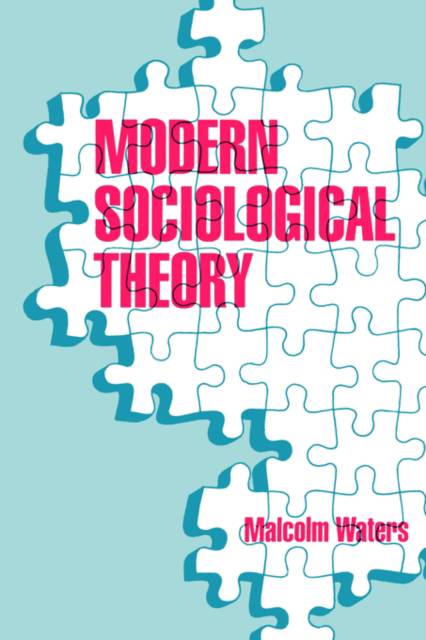
Innovative and engaging, Modern Sociological Theory offers a different and illuminating framework for the study of social theory. Malcolm Waters provides readers with a lucid overview of the core concepts that sociological theory must address and attempt to reconcile--agency, rationality, structure, and system. Moreover, he examines the main phenomena that sociological theory seeks to explain--culture, power, gender, differentiation, and stratification. Unique in his approach, he not only explains the major contribution to the analysis of each concept or phenomenon by both classical and contemporary theorists, but also links these ideas to current sociological issues, such as change and globalization, feminism and social theory, and the return to cultural analysis. And, by focusing on the core concepts and issues--rather than on schools of thought or individual theorists--he clearly relates past and present theory to the key concerns of sociology today. Covering a wide range of material in an accessible way, Modern Sociological Theory serves as an invaluable resource for all students of sociology and social theory. It will also be of great interest to scholars and students in cultural studies, women′s studies, organization studies, and urban studies. "The publication of Modern Sociological Theory marks a new stage in the teaching of contemporary social theory. In contrast to texts based on individual thinkers or ritualized accounts of schools, Waters provides an ingenious analytical framework for presenting virtually all of the major issues of contemporary social theory; from the varieties of interactionism to rational choice and exchange theory; structuralism and poststructuralism; functionalism and neofunctionalism; feminist theory to the latest variations in new-Marxist, critical and postmodernist theory. It′s what we have been waiting for and more. A focus on agency, rationality, structure, and system effectively sets out the unifying terms of debate. Moreover, substantively oriented chapters on culture and ideology, power, gender, and stratification link social theory and empirical research in an unparalleled manner. The major individual contributors are concisely presented, and helpful charts quickly convey the relations among abstract concepts. In short, there is no current text that can begin to compare with respect to scope, range, clarity, balance, and sophistication. But this book is not only for moving students rapidly to the frontier of theory, it is also a must read for anyone interested in catching up with the transformations of social theory over the past two decades. Those not using it for their courses will probably be relying on it for rewriting their lecture notes." --Raymond A. Morrow, University of Alberta
Spécifications
Parties prenantes
- Auteur(s) :
- Editeur:
Contenu
- Nombre de pages :
- 384
- Langue:
- Anglais
Caractéristiques
- EAN:
- 9780803985322
- Date de parution :
- 21-01-94
- Format:
- Livre broché
- Format numérique:
- Trade paperback (VS)
- Dimensions :
- 163 mm x 233 mm
- Poids :
- 635 g


Seulement chez Librairie Club
+ 502 points sur votre carte client de Librairie Club
Cadeau


Les avis
Nous publions uniquement les avis qui respectent les conditions requises. Consultez nos conditions pour les avis.