


- Retrait en 2 heures
- Assortiment impressionnant
- Paiement sécurisé
- Toujours un magasin près de chez vous
- Retrait en 2 heures
- Assortiment impressionnant
- Paiement sécurisé
- Toujours un magasin près de chez vous



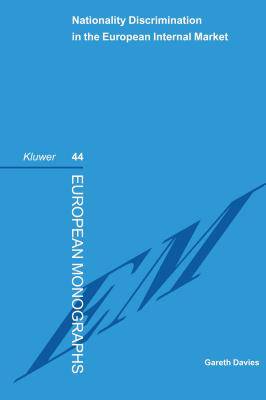
Nationality Discrimination in the European Internal Market
M Davies
90,48 €
+ 180 points
Description
Despite the high-flown rhetoric of civil society in recent decades, it cannot be denied that discrimination is still with us; it has merely gone 'underground'. In the European project, and particularly in the etiology of the EC Treaty's commitment to the free movement of persons, defenders of national sovereignty are often also defenders of inequality. Here is an utterly fresh approach to this all-important issue that exposes, in rigorous and well-informed detail, a polity that defines discrimination correctly but then refuses to see it where it occurs. Nationality Discrimination in the European Internal Market approaches the law of free movement from a point of view that is regrettably uncommon: neither that of market integration, nor that of Member State sovereignty within the Union, but that of the individual dignity subsumed in the state-citizen relationship.Focusing on the relevant caselaw of the European Court of Justice Gareth Davies shows that the law of cross-border movement in Europe can and should be guided by the principle of non-discrimination; that, despite inconsistencies in its judgments, and a tendency to retreat to the neutral language of economics, the Court is 'haunted' by the discriminatory principles inherent in formalistic European legal systems. Its jurisprudence will ultimately restructure them to impose respect for difference and equality before the law.Specific issues treated in depth include the following: the definition and use of discrimination by the Court of Justiceimplications of free movement law for welfare provision, including health care and educationthe application of Community law to internal situations, resulting in ¿reverse discriminationthe legality of privately created obstacles to free movement.Practitioners, policymakers, academics, lawyers and political scientists interested in the larger, longer-term purposes of the European Union¿to change and open up in order to avoid repeating the past destructive patterns of behaviour of the Member States¿will find in this insightful and well-researched study a source of inspiration and a well-positioned foundation for an energetic and prosperous Europe based on individual freedom through equal rights. Review(s) 'It is rare for a book to go over a well-trodden theme and yet manage to remain fresh and inspiring. This should definitely be on the reading list of anybody with an interest in the internal market.' Nick Bernard, European Law Review 'The book is a well-researched in-depth study on the prohibition of discrimination; while the author builds on a well-established body of black letter law, he succeeds in adding appreciably to the standard corpus of free movement law.' Common Market Law Review
Spécifications
Parties prenantes
- Auteur(s) :
- Editeur:
Contenu
- Nombre de pages :
- 242
- Langue:
- Anglais
- Collection :
Caractéristiques
- EAN:
- 9789041119988
- Date de parution :
- 24-01-03
- Format:
- Livre relié
- Format numérique:
- Genaaid
- Dimensions :
- 156 mm x 234 mm
- Poids :
- 517 g


Seulement chez Librairie Club
+ 180 points sur votre carte client de Librairie Club
Cadeau


Les avis
Nous publions uniquement les avis qui respectent les conditions requises. Consultez nos conditions pour les avis.