


- Retrait en 2 heures
- Assortiment impressionnant
- Paiement sécurisé
- Toujours un magasin près de chez vous
- Retrait en 2 heures
- Assortiment impressionnant
- Paiement sécurisé
- Toujours un magasin près de chez vous



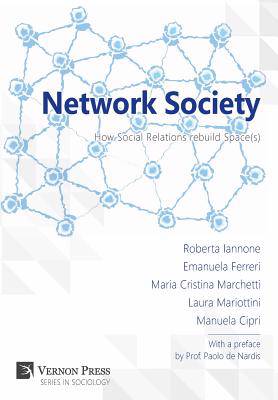
Network Society; How Social Relations rebuild Space(s)
How Social Relations Rebuild Spaces
Roberta Iannone, Emanuela Ferreri, Maria Cristina Marchetti
115,45 €
+ 230 points
Format
Description
The present volume attempts to critically evaluate claims that modern society may be read and understood as a network. Accepting that this perspective holds some potential, the question becomes how to best capitalize on it. To analyze society as a network means to respond not only to the "actual needs", but also to highlight the "opportunities" and the "utilities", and to investigate whether society is increasingly relational or just perceived as such, as e.g. digital "social networks" and related concepts exemplify. From a strictly scientific perspective to answer the question "how to" read society as a network means to ask ourselves: a) if the conceptual categories (especially the concepts of structure and exchange) and the paradigms of traditional analysis (holism and individualism, both in the functionalist and the conflictive versions) are still sufficient; b) if new conceptual categories/theories/instruments are needed to represent more properly the reality we face: to investigate it, to explain it or, at least, to understand it. Starting from a reflection on already established social networks (Scott, 2003), the fundamental differences between groups and networks (Vergati, 2008), the logics of networks (Serra, 2003) as well as social capital formation and links (Di Nicola, 2006; Mutti, 1998), we seize the spatial dynamics, seemingly following opposite paths, but which revert to a common denominator: de-spatialization and re-spatialization, namely the processes of dematerialization of space(s) and its reconstruction by specific relational dynamics and forms. The study of networks is therefore not attributable to a single theory but to several theories converging towards a unique perspective (spaces) and logical reasoning (Serra, 2001) each one with its own uniqueness. The strength of this volume and the difference with respect to other attempts at explaining the Network Society lies in the multidimensional and interrelated perspectives it offers emerging from converging multidisciplinary perspectives (sociological, anthropological and linguistic), and from applications that the Network Society provides, namely, international (European Governance), institutional, public (linguistic landscape of the city of Rome) and mediated ones (communication technology).
Spécifications
Parties prenantes
- Auteur(s) :
- Editeur:
Contenu
- Nombre de pages :
- 232
- Langue:
- Anglais
- Collection :
Caractéristiques
- EAN:
- 9781622730407
- Date de parution :
- 12-07-16
- Format:
- Livre relié
- Format numérique:
- Genaaid
- Dimensions :
- 152 mm x 229 mm
- Poids :
- 467 g


Seulement chez Librairie Club
+ 230 points sur votre carte client de Librairie Club
Cadeau


Les avis
Nous publions uniquement les avis qui respectent les conditions requises. Consultez nos conditions pour les avis.