


- Retrait en 2 heures
- Assortiment impressionnant
- Paiement sécurisé
- Toujours un magasin près de chez vous
- Retrait gratuit dans votre magasin Club
- 7.000.0000 titres dans notre catalogue
- Payer en toute sécurité
- Toujours un magasin près de chez vous



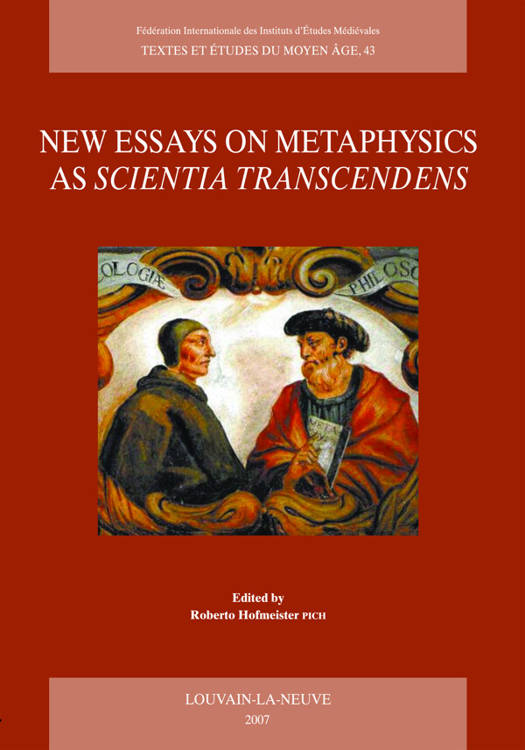
New Essays on Metaphysics as Scientia Transcendens
Proceedings of the Second International Conference of Medieval Philosophy, Held at the Pontifical Catholic University of Rio Grande Do Sul (Pucrs), Porto Alegre/Brazil, 15-18 August 2006
R. Hofmeister Pich
45,58 €
+ 91 points
Description
This volume is not an historical study of the origins and development of medieval approaches to theories of transcendentals. Its point of departure is rather the role that transcendentals played in natural theology and metaphysical theories of the 13th. and 14th. centuries. Accordingly, the effort of John Duns Scotus (1265/6-1308) to systematize a theory of transcendental concepts provides the central inspiration for this book. The theories in focus are not only linked to metaphysical issues, but come to constitute the understanding of metaphysics as First Philosophy. In the wake of the 13th-century reception of Aristotle, Scotus inaugurates a new beginning for the science of reality as a whole, adumbrating theoretical elements that have exercised a remarkable influence on the history of philosophy and continue to do so today. If Scotus offers a new understanding and a new systematic account of transcendentals in the form of an original conception of First Philosophy as the science of transcendentals - a conception which many believe introduces a second beginning of metaphysics within Western philosophy - the essays in this volume evaluate the innovations that his work inspired, and in this sense each of them is itself innovative. They offer a candid evaluation of the extrinsic and intrinsic merits of the Scotist interpretation - that is, they examine just how original the intepretation is within the history of ideas, and assess its internal consistency. In doing so, they take account of earlier philosophical attempts to understand both the interrelationship of transcendentals and the science of metaphysics. They also offer topical and expanded analyses of various elements of Scotus's theory, as well as of its influence and developments within Scotist circles and the Franciscan tradition, as well as within Spanish scholasticism and the philosophical theology of our times.
Spécifications
Parties prenantes
- Auteur(s) :
- Editeur:
Contenu
- Nombre de pages :
- 388
- Langue:
- Anglais
- Collection :
- Tome:
- n° 43
Caractéristiques
- EAN:
- 9782503527871
- Date de parution :
- 18-11-08
- Format:
- Livre broché
- Format numérique:
- Trade paperback (VS)
- Dimensions :
- 158 mm x 239 mm
- Poids :
- 680 g


Seulement chez Librairie Club
+ 91 points sur votre carte client de Librairie Club
Cadeau

Cadeau


Les avis
Nous publions uniquement les avis qui respectent les conditions requises. Consultez nos conditions pour les avis.