


En raison d'une grève chez bpost, des retards de livraison peuvent survenir. Besoin de quelque chose en urgence ? Optez pour un retrait en magasin ou rendez-vous dans une Librairie Club à proximité.
- Retrait en 2 heures
- Assortiment impressionnant
- Paiement sécurisé
- Toujours un magasin près de chez vous
En raison d'une grève chez bpost, des retards de livraison peuvent survenir. Besoin de quelque chose en urgence ? Optez pour un retrait en magasin ou rendez-vous dans une Librairie Club à proximité.
- Retrait en 2 heures
- Assortiment impressionnant
- Paiement sécurisé
- Toujours un magasin près de chez vous




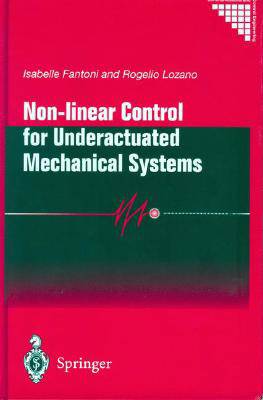
Non-Linear Control for Underactuated Mechanical Systems
R Lozano, Isabelle Fantoni, I Fantoni, Rogelio Lozano
151,45 €
+ 302 points
Description
1 Introduction.- 1.1 Motivation.- 1.2 Outline of the book.- 1.2.1 Energy-based control approaches for several underactuated mechanical systems.- 1.2.2 The hovercraft model, the PVTOL aircraft and the helicopter.- 2 Theoretical preliminaries.- 2.1 Lyapunov stability.- 2.2 Lyapunov direct method.- 2.3 Passivity and dissipativity.- 2.4 Stabilization.- 2.5 Non-holonomic systems.- 2.6 Underactuated systems.- 2.7 Homoclinic orbit.- 3 The cart-pole system.- 3.1 Introduction.- 3.2 Model derivation.- 3.2.1 System model using Newton's second law.- 3.2.2 Euler-Lagrange's equations.- 3.3 Passivity of the inverted pendulum.- 3.4 Controllability of the linearized model.- 3.5 Stabilizing control law.- 3.5.1 The homoclinic orbit.- 3.5.2 Stabilization around the homoclinic orbit.- 3.5.3 Domain of attraction.- 3.3 Stability analysis.- 3.4 Simulation results.- 3.5 Experimental results.- 3.6 Conclusions.- 4 A convey-crane system.- 4.1 Introduction.- 4.2 Model.- 4.3 Passivity of the system.- 4.4 Damping oscillations control law.- 4.5 Asymptotic stability analysis.- 4.6 Simulation results.- 4.7 Concluding remarks.- 5 The pendubot system.- 5.1 Introduction.- 5.2 System dynamics.- 5.2.1 Equations of motion via Euler-Lagrange formulation.- 5.3 Passivity of the pendubot.- 5.4 Linearization of the system.- 5.5 Control law for the top position.- 5.5.1 The homoclinic orbit.- 5.5.2 Stabilization around the homoclinic orbit.- 5.6 Stability analysis.- 5.7 Simulation results.- 5.8 Experimental results.- 5.9 Conclusions.- 6 The Furuta pendulum.- 6.1 Introduction.- 6.2 Modeling of the system.- 6.2.1 Energy of the system.- 6.2.2 Euler-Lagrange dynamic equations.- 6.3.3 Passivity properties of the Furuta pendulum.- 6.3 Controllability of the linearized model.- 6.4 Stabilization algorithm.- 6.5 Stability analysis.- 6.6 Simulation results.- 6.7 Conclusions.- 7 The reaction wheel pendulum.- 7.1 Introduction.- 7.2 The reaction wheel pendulum.- 7.2.1 Equations of motion.- 7.2.2 Passivity properties of the system.- 7.2.3 Linearization of the system.- 7.2.4 Feedback linearization.- 7.3 First energy-based control design.- 7.4 Second energy-based controller.- 7.5 Simulation results.- 7.6 Conclusions.- 7.7 Generalization for Euler-Lagrange systems.- 8 The planar flexible-joint robot.- 8.1 Introduction.- 8.2 The two-link planar robot.- 8.2.1 Equations of motion.- 8.2.2 Linearization of the system.- 8.2.3 Passivity of the system.- 8.3 Control law for the two-link manipulator.- 8.3.1 Equivalent closed-loop interconnection.- 8.4 Stability analysis.- 8.5 Simulation results.- 8.6 The three-link planar robot.- 8.7 Control law for the three-link robot.- 8.8 Stability analysis.- 8.9 Simulation results.- 8.10 Conclusions.- 9 The PPR planar manipulator.- 9.1 Introduction.- 9.2 System dynamics.- 9.2.1 Equations of motion via Euler-Lagrange formulation.- 9.2.2 Passivity properties of the planar PPR manipulator.- 9.3 Energy-based stabilizing control law.- 9.3.1 Equivalent closed-loop interconnection.- 9.4 Convergence and stability analysis.- 9.5 Simulation results.- 9.6 Conclusions.- 10 The ball and beam acting on the ball.- 10.1 Introduction.- 10.2 Dynamical model.- 10.2.1 Mechanical properties.- 10.3 The control law.- 10.3.1 Stability analysis.- 10.4 Simulation results.- 10.5 Conclusions.- 11 The hovercraft model.- 11.1 Introduction.- 11.2 The hovercraft model.- 11.2.1 System model using Newton's second law.- 11.2.2 Euler-Lagrange's equations.- 11.2.3 Controllability of the linearized system.- 11.3 Stabilizing control law for the velocity.- 11.4 Stabilization of the position>.- 11.4.1 First approach.- 11.4.2 Second approach.- 11.4.3 Third approach.- 11.5 Simulation results.- 11.6 Conclusions.- 12 The PVTOL aircraft.- 12.1 Introduction.- 12.2 The PVTOL aircraft model.- 12.3 Input-output linearization of the system.- 12.4 Second stabilization approach.- 12.5 Third stabilization algorithm.- 12.6 Forwarding control law.- 12.6.1 First step: a Lyapunov function for the altitudeangle (y, ...
Spécifications
Parties prenantes
- Auteur(s) :
- Editeur:
Contenu
- Nombre de pages :
- 312
- Langue:
- Anglais
- Collection :
Caractéristiques
- EAN:
- 9781852334239
- Date de parution :
- 28-11-01
- Format:
- Livre relié
- Format numérique:
- Genaaid
- Dimensions :
- 156 mm x 234 mm
- Poids :
- 612 g


Seulement chez Librairie Club
+ 302 points sur votre carte client de Librairie Club
Cadeau


Les avis
Nous publions uniquement les avis qui respectent les conditions requises. Consultez nos conditions pour les avis.