


- Retrait en 2 heures
- Assortiment impressionnant
- Paiement sécurisé
- Toujours un magasin près de chez vous
- Retrait gratuit dans votre magasin Club
- 7.000.0000 titres dans notre catalogue
- Payer en toute sécurité
- Toujours un magasin près de chez vous



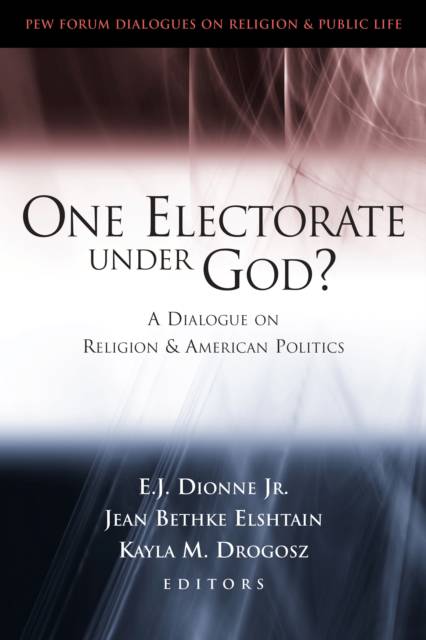
One Electorate Under God?
A Dialogue on Religion and American Politics
47,45 €
+ 94 points
Description
The United States has been described as a nation with the soul of a church. Religion is discussed more explicitly and more urgently in American politics than in the public debates of any other wealthy democracy. It is certain to play an important role in the elections of 2004. Yet debates over religion and politics are often narrow and highly partisan, although the questions at hand demand a broader and more civil discussion. One Electorate under God? widens the dialogue by bringing together in one volume some of the most influential voices in American intellectual and political life. This book draws on a public debate between former New York governor Mario Cuomo and Indiana congressman Mark Souder, who discuss how their respective faith convictions have been both shaped by and reflected in their careers as public servants. This discussion, in turn, prompted commentary by a diverse group of scholars, politicians, journalists, and religious leaders who are engaged simultaneously in the religious and policy realms. Each contributor offers insights on how political leaders and religious convictions shape our politics. One Electorate under God arises from the idea that public deliberation is more honest--and more democratic--when officials are open and reflective about the interactions between their religious convictions and their commitments in the secular realm. This volume--the first of its kind--seeks to promote a greater understanding of American thinking about faith and public office in a pluralistic society. Contributors include Joanna Adams, Azizah Al-Hibri, Doug Bandow, Michael Barone, Gary Bauer, Robert Bellah, David Brooks, Harvey Cox, Michael Cromartie, John DiIulio Jr., Terry Eastland, Robert Edgar, Jean Bethke Elshtain, Richard Wightman Fox, William Galston, Robert George, Andrew Greeley, John Green, Anna Greenberg, Susannah Heschel, Representative Amo Houghton (R-New York), Michael Kazin, Martha Minow, Stephen Monsma, Mark Noll, Rabbi David Novak, Ramesh Ponnuru, Representative David E. Price (D-North Carolina), Jeffrey Rosen, Cheryl Sanders, Ron Sider, Jim Skillen, Matthew Spalding, Jeffrey Stout, John Sweeney, Roberto Suro, Margaret O'Brien Steinfels, Jim Towey, Doug Tanner, Mark Warren, Alan Wolfe, and Andrew Young.
Spécifications
Parties prenantes
- Editeur:
Contenu
- Nombre de pages :
- 256
- Langue:
- Anglais
- Collection :
Caractéristiques
- EAN:
- 9780815716433
- Date de parution :
- 14-06-2004
- Format:
- Livre broché
- Format numérique:
- Trade paperback (VS)
- Dimensions :
- 156 mm x 229 mm
- Poids :
- 390 g

Seulement chez Librairie Club
+ 94 points sur votre carte client de Librairie Club
Cadeau

Cadeau


Les avis
Nous publions uniquement les avis qui respectent les conditions requises. Consultez nos conditions pour les avis.