


- Retrait en 2 heures
- Assortiment impressionnant
- Paiement sécurisé
- Toujours un magasin près de chez vous
- Retrait en 2 heures
- Assortiment impressionnant
- Paiement sécurisé
- Toujours un magasin près de chez vous



34,95 €
+ 69 points
Description
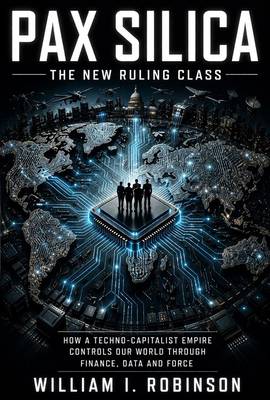
Pax Silica: The New Ruling Class explores the emergence of a new global order in which power is increasingly concentrated in the hands of a techno-capitalist elite. Robinson traces the rise of a "new capital complex" that brings big tech together with global finance and the military-industrial-repression complex. The chaos that now engulfs the world is driven by the predatory strategies of this complex as it seeks to seize markets, land, and resources needed for the AI revolution.
In order to advance its interests, the complex is moving into alignment with authoritarian, dictatorial and fascist states as the tech and financial billionaires become global geopolitical actors. They are deeply invested in transnational systems of warfare, social control, repression and surveillance that are digitalized, automated, and embedded in the global economy and society.
The new ruling class has concluded that the crisis of global capitalism can only be overcome by violently cracking open new spaces for accumulation, by transferring the cost of the crisis to the working classes, and by aligning states and political systems worldwide with its agenda. The consolidation of Pax Silica, Robinson argues, thus hinges on the ideological extremism and political warlordism of "Global Trumpism" and other ruling class mafias as the post-World War II international order crumbles and as geopolitical confrontation escalates. In this way, the economic totalitarianism that has come about over the past half century of neoliberalism and acute inequality is now translating into a political totalitarianism of a new type as the Pax Silica complex sets out to convert the chaos into new strategies for the accumulation of capital and power.
Yet the fascist state remains embryonic. The ruling class is not omnipotent. Robinson sees great hope in the mass resistance movements and youth-led revolts that are proliferating around the world. These popular forces from below offer an alternative future, one based not on the domination of capital but on the needs of toiling majorities and the empowerment of working-class communities. If Pax Silica offers an urgent warning about a possible tragic future, it also provides a critical framework for understanding the global maelstrom and what it means for popular resistance and emancipatory struggles.
In order to advance its interests, the complex is moving into alignment with authoritarian, dictatorial and fascist states as the tech and financial billionaires become global geopolitical actors. They are deeply invested in transnational systems of warfare, social control, repression and surveillance that are digitalized, automated, and embedded in the global economy and society.
The new ruling class has concluded that the crisis of global capitalism can only be overcome by violently cracking open new spaces for accumulation, by transferring the cost of the crisis to the working classes, and by aligning states and political systems worldwide with its agenda. The consolidation of Pax Silica, Robinson argues, thus hinges on the ideological extremism and political warlordism of "Global Trumpism" and other ruling class mafias as the post-World War II international order crumbles and as geopolitical confrontation escalates. In this way, the economic totalitarianism that has come about over the past half century of neoliberalism and acute inequality is now translating into a political totalitarianism of a new type as the Pax Silica complex sets out to convert the chaos into new strategies for the accumulation of capital and power.
Yet the fascist state remains embryonic. The ruling class is not omnipotent. Robinson sees great hope in the mass resistance movements and youth-led revolts that are proliferating around the world. These popular forces from below offer an alternative future, one based not on the domination of capital but on the needs of toiling majorities and the empowerment of working-class communities. If Pax Silica offers an urgent warning about a possible tragic future, it also provides a critical framework for understanding the global maelstrom and what it means for popular resistance and emancipatory struggles.
Spécifications
Parties prenantes
- Auteur(s) :
- Editeur:
Contenu
- Nombre de pages :
- 200
- Langue:
- Anglais
Caractéristiques
- EAN:
- 9781963892420
- Date de parution :
- 01-10-26
- Format:
- Livre broché
- Format numérique:
- Trade paperback (VS)
- Dimensions :
- 152 mm x 229 mm
- Poids :
- 421 g


Seulement chez Librairie Club
+ 69 points sur votre carte client de Librairie Club
Cadeau


Les avis
Nous publions uniquement les avis qui respectent les conditions requises. Consultez nos conditions pour les avis.