


- Retrait en 2 heures
- Assortiment impressionnant
- Paiement sécurisé
- Toujours un magasin près de chez vous
- Retrait en 2 heures
- Assortiment impressionnant
- Paiement sécurisé
- Toujours un magasin près de chez vous



435,45 €
+ 870 points
Description
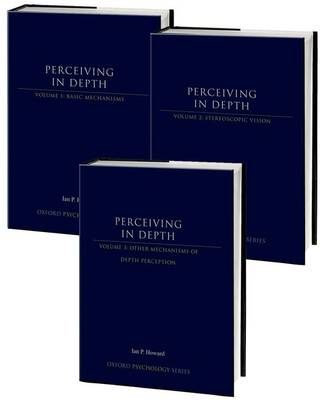
The three-volume work Perceiving in Depth is a sequel to Binocular Vision and Stereopsis and to Seeing in Depth, both by Ian P. Howard and Brian J. Rogers. This work is much broader in scope than the previous books and includes mechanisms of depth perception by all senses, including aural, electrosensory organs, and the somatosensory system. Volume 1 reviews sensory coding, psychophysical and analytic procedures, and basic visual mechanisms. Volume 2 reviews stereoscopic vision. Volume 3 reviews all mechanisms of depth perception other than stereoscopic vision. The three volumes are extensively illustrated and referenced and provide the most detailed review of all aspects of perceiving the three-dimensional world. Volume 2 addresses stereoscopic vision in cats and primates, including humans. It begins with an account of the physiology of stereoscopic mechanisms. It then deals with binocular rivalry, binocular summation, binocular masking, and the interocular transfer of visual effects, such as the motion aftereffect and visual learning. The geometry of the region in binocular space that creates fused images (the horopter) is discussed in some detail. Objects outside the horopter produce images with binocular disparities that are used for stereoscopic vision. Two chapters provide accounts of mechanisms that bring the images into binocular register and of stimulus tokens that are used to detect binocular disparities. Another chapter discusses cyclopean effects, such as cyclopean illusions, cyclopean motion, and binocular direction that are seen only with binocular vision. Stereoacuity is the smallest depth interval that can be detected. Methods of measuring stereoacuity and factors that influence it are discussed. Two chapters deal with the various types of binocular disparity and the role of each type in stereoscopic vision. Another chapter deals with visual effects, such as figure perception, motion perception, and whiteness perception that are affected by the relative distances of stimuli. The spatiotemporal aspects of stereoscopic vision, including the Pulfrich stereomotion effect are reviewed. The volume ends with an account of techniques used to create stereoscopic displays and of the applications of stereoscopy.
Spécifications
Parties prenantes
- Auteur(s) :
- Editeur:
Contenu
- Nombre de pages :
- 648
- Langue:
- Anglais
- Collection :
- Tome:
- n° 29
Caractéristiques
- EAN:
- 9780199764150
- Date de parution :
- 24-02-12
- Format:
- Livre relié
- Format numérique:
- Genaaid
- Dimensions :
- 218 mm x 284 mm
- Poids :
- 2267 g


Seulement chez Librairie Club
+ 870 points sur votre carte client de Librairie Club
Cadeau


Les avis
Nous publions uniquement les avis qui respectent les conditions requises. Consultez nos conditions pour les avis.