


- Retrait en 2 heures
- Assortiment impressionnant
- Paiement sécurisé
- Toujours un magasin près de chez vous
- Retrait en 2 heures
- Assortiment impressionnant
- Paiement sécurisé
- Toujours un magasin près de chez vous




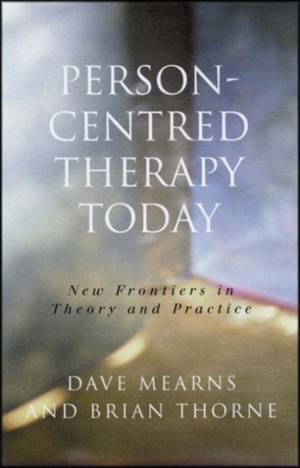
Person-Centred Therapy Today
New Frontiers in Theory and Practice
Dave Mearns, Brian Thorne
Livre broché | Anglais
369,45 €
+ 738 points
Format
Description
`At the risk of being directive, I would say you should buy this book. It contains some of the most stimulating and refreshing ideas to have emerged in the person-centred literature since On Becoming a Person ′- Person Centred Practice Person-Centred Therapy Today makes a timely and significant contribution to the development of one of the most popular and widely-used therapeutic approaches. `This is a book that is rooted in the origins of person-centred therapy but stands at the cutting edge of new ideas developing in this tradition. It will reinvigorate those of us already immersed in this tradition. It should convince newcomers of the vitality and potential of this approach to therapy′ - Tim Bond, University of Bristol `This book is clearly a labour of love by two authors with unique abilities and unparalleled experience: readers will be educated, inspired and encouraged in their own dialogue with the person-centred approach′- Charles J. O′Leary, Denver Colorado `Mearns and Thorne have done Rogers proud in suggesting how person-centred theory and practice can, without losing its essence, evolve in new directions′ - Richard Nelson-Jones, Director, Cognitive Institute, Chiang Mai, Thailand Dave Mearns and Brian Thorne are well known internationally as leading experts and authors of the bestselling Person-Centred Counselling in Action, a classic text which has been the cornerstone of training in the approach for over a decade. Written in the same vivid and engaging style, Person-Centred Therapy Today explores what it means to be `person-centred′ in the twenty-first century and outlines key philosophical challenges to the approach. The authors robustly answer critics who have labelled person-centred therapy `westernised′, `unmanly′ and `anti-intellectual′. The book breaks new ground in presenting the authors′ reworking of Carl Rogers′ theory of the Self, an innovation which has been years in the making and has implications for both theory and practice. Central to the book are two chapters which describe how the Self is constructed as a collection of different parts or `configurations′. Using vivid examples chosen from their own practice, Dave Mearns and Brian Thorne show how this theory contributes directly to the therapist′s understanding and interactions with clients. Person-Centred Therapy Today represents a significant contribution to the development of the person-centred approach. It will be read by teachers and students of counselling and psychology who wish to keep their knowledge of the approach fully up-to-date and by all who consider themselves to be person-centred in their approach to helping clients.
Spécifications
Parties prenantes
- Auteur(s) :
- Editeur:
Contenu
- Nombre de pages :
- 256
- Langue:
- Anglais
Caractéristiques
- EAN:
- 9780761965602
- Date de parution :
- 13-11-00
- Format:
- Livre broché
- Format numérique:
- Trade paperback (VS)
- Dimensions :
- 148 mm x 223 mm
- Poids :
- 385 g


Seulement chez Librairie Club
+ 738 points sur votre carte client de Librairie Club
Cadeau


Les avis
Nous publions uniquement les avis qui respectent les conditions requises. Consultez nos conditions pour les avis.