


- Retrait en 2 heures
- Assortiment impressionnant
- Paiement sécurisé
- Toujours un magasin près de chez vous
- Retrait gratuit dans votre magasin Club
- 7.000.0000 titres dans notre catalogue
- Payer en toute sécurité
- Toujours un magasin près de chez vous

Description
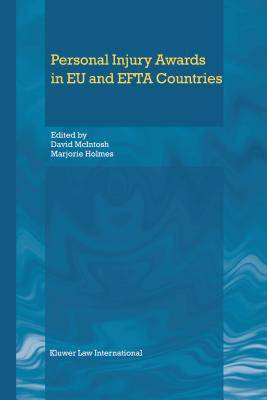
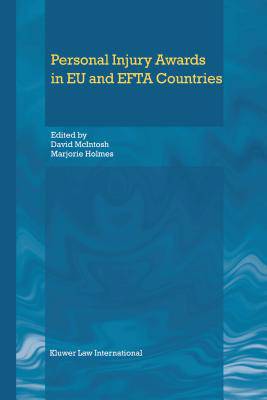
Following the success of our previous two reports relating to 'Personal Injury Awards in EU and EFTA Countries' we have undertaken some further research to produce a third edition. The report provides a guide to an understanding of the personal injury awards system in both the European Union (EU) and European Free Trading Area (EFTA), and looks at the changes that have taken place over the past 12 years. The research compares the levels of compensation awarded to individuals within the member states and sets out recommendations from our experts for future procedures. We have used schedules, tables, graphs and commentary in the report to demonstrate our findings of each country's method of calculation and the compensation levels which could be expected by two types of hypothetical victim. The information provides a comparison of levels of compensation awarded for personal injury in each of these member countries. As yet, no provision has been made for harmonization of levels of awards in the EC and there are no draft directives or intended draft directives aimed at bringing about uniformity. Research shows that compensation awards vary considerably from country to country, which has an obvious bearing on legal advice to clients concerning where claims should be heard. Levels of award everywhere are influenced by the age and financial status of the injured party, but such factors are weighted differently in each country. In addition, awards for any one type of injury vary between jurisdictions. In order to offer a client the best possible advice on where to sue; a lawyer must be able to compare the levels of awards in the various countries. Large discrepancies between Italian and French awards are revealed as a consequence of the tragic Mont Blanc tunnel fire: Italian awards in fatal cases, depending on the personal status of the victim, are 3-4 times higher than the equivalent French awards. The text covers 20 jurisdictions, including a separate section on Scotland. It looks in detail at the methods of calculation in each member state by reference to schedules, tables, graphs and commentary on each country's system and the compensation levels which could be expected by two types of hypothetical victim. Potential awards to a married male doctor with two children are compared with those to an unmarried female legal secretary for 14 types of injury in each of these countries. For example, an unmarried female legal secretary with an injury that results in blindness will collect £ 610,469 in Italy, which is the largest award for that injury in the EU, and £100,000 in Austria, which is one of the smallest. If the legal secretary died, she'd be worth 140 times more in Italy than in England. In striving for improvement we have added: Exchange rate analyses and inflation comparisons across Europe. Further categories of common injuries, namely, deafness, the concept of repetitive strain for several EU and EFTA countries and a schedule for stress (for England and Wales only). Block graphs to cover more injuries rather than the limited selection produced in the edition. An analysis of the changes which have taken place since the original survey and the survey for the second edition (1994) were carried out.
Spécifications
Parties prenantes
- Auteur(s) :
- Editeur:
Contenu
- Nombre de pages :
- 663
- Langue:
- Anglais
Caractéristiques
- EAN:
- 9789041120090
- Date de parution :
- 31-05-03
- Format:
- Livre relié
- Format numérique:
- Genaaid
- Dimensions :
- 156 mm x 234 mm
- Poids :
- 1102 g


Seulement chez Librairie Club
+ 526 points sur votre carte client de Librairie Club
Cadeau

Cadeau


Les avis
Nous publions uniquement les avis qui respectent les conditions requises. Consultez nos conditions pour les avis.