


- Retrait en 2 heures
- Assortiment impressionnant
- Paiement sécurisé
- Toujours un magasin près de chez vous
- Retrait gratuit dans votre magasin Club
- 7.000.0000 titres dans notre catalogue
- Payer en toute sécurité
- Toujours un magasin près de chez vous



Description
Abstracts
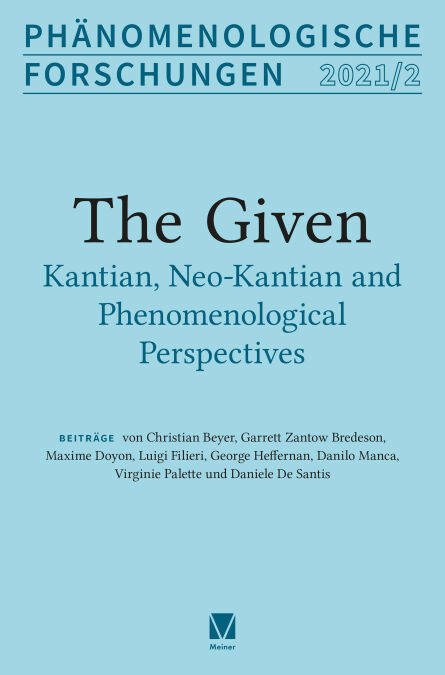
De Santis, Daniele, Manca, Danilo: Introduction. The Given: Historical and Hermeneutical Category or Laziness and Perversion of Reason?
Filieri, Luigi: Sellars and Kant on Givenness and Intuition.
In this paper, I argue that Sellars's conceptualist reading of Kant, though less radical than more contemporary approaches (e. g., Brandom, McDowell), relies on a controversial account of the relations between the givenness of intuitions, the productive imagination and the power of judgment. I will discuss: 1) how Sellars reconsidered Kant's account of intuition; and 2) the kind of conceptualism he argues for. I will raise two main claims. First, Sellars's conceptualist reading of intuition overlooks the role of space and time as givenness conditions. Second, Sellars's account of the productive imagination disregards the complementary significance of the power of judgment in a priori synthesis, the role of which is to grant synthetic unity. My aim is to reconstruct a consistent dialogue between Sellars and Kant by discussing Sellars's reading of a priori synthesis and comparing his views to Kant's original aims.
Bredeson, Garrett Zantow: Natorp's Critique of Appeals to Givenness in Light of the Marburg Renewal of Idealism.
For Natorp, the most urgent task for turn-of-the-century philosophy consisted in recovering the meaning of idealism. Instead of simply appealing to given facts, idealists transform givennesses of all sorts into tasks for thinking under the guidance of laws which we ourselves have laid down and for which we ourselves are responsible. In this paper I will try to connect the dots between (a) the broader Marburg project of tethering philosophy to the achievements of modern science and (b) Natorp's critique of his contemporaries' appeals to givenness. Understanding this connection is, in my view, crucial for appreciating the sense and grounding of Natorp's idealism.
Palette, Virginie: The Resistance of the Given and its Demythologization in Husserl's Phenomenology.
The objective of this paper is to reconstruct Husserl's two-pronged approach of sensory givenness. On the one hand, the phenomenological focus on intentional consciousness implies a virulent criticismof the positivistic myth of the sensory given. On the other hand, there is also a positive appeal to sensory givenness in phenomenology, without which phenomenology would not be worthy of its name and would, ultimately, be nothing other than a form of neo-Kantianism. In the context of transcendental genetic phenomenology, Husserl manages to rehabilitate sensory givenness in a reduced, viz. demythologized form. This reconstruction of Husserl's ambivalent reference to the given can help phenomenology defend itself against some actual trends, which tend to reduce it to phenomenalismor to conceptualism.
Manca, Danilo: Spontaneity and Givenness. Natorp, Husserl, and Sellars's Neo-Kantianism.
In this article, I propose a comparison between Natorp, Husserl, and Sellars that has a twofold aim. First, I ask to what extent Sellars's perspective can be considered to be Neo-Kantian. Second, I demonstrate that the point of divergence among these three thinkers does not have to do with the role they ascribe to givenness in knowledge, but with the way they conceive the activity of thinking. Focusing on Husserl's reading of Natorp's theses concerning the subjective and objective ground of knowledge, I show that both Natorp and Husserl agree with Sellars on the limits of a positivistic and empiricist perspective that relies on what is given in perception for the justification of one's epistemic beliefs. On the other hand, the differences between the three thinkers emerge as soon as we consider how they attempt to integrate the spontaneity of thinking into the sphere of intuition from a renewed Kantian perspective.
De Santis, Daniele: Thought, Being, and the Given in Hans Vaihinger's Die Philosophie des Als Ob.
De Santis, Daniele, Manca, Danilo: Introduction. The Given: Historical and Hermeneutical Category or Laziness and Perversion of Reason?
Filieri, Luigi: Sellars and Kant on Givenness and Intuition.
In this paper, I argue that Sellars's conceptualist reading of Kant, though less radical than more contemporary approaches (e. g., Brandom, McDowell), relies on a controversial account of the relations between the givenness of intuitions, the productive imagination and the power of judgment. I will discuss: 1) how Sellars reconsidered Kant's account of intuition; and 2) the kind of conceptualism he argues for. I will raise two main claims. First, Sellars's conceptualist reading of intuition overlooks the role of space and time as givenness conditions. Second, Sellars's account of the productive imagination disregards the complementary significance of the power of judgment in a priori synthesis, the role of which is to grant synthetic unity. My aim is to reconstruct a consistent dialogue between Sellars and Kant by discussing Sellars's reading of a priori synthesis and comparing his views to Kant's original aims.
Bredeson, Garrett Zantow: Natorp's Critique of Appeals to Givenness in Light of the Marburg Renewal of Idealism.
For Natorp, the most urgent task for turn-of-the-century philosophy consisted in recovering the meaning of idealism. Instead of simply appealing to given facts, idealists transform givennesses of all sorts into tasks for thinking under the guidance of laws which we ourselves have laid down and for which we ourselves are responsible. In this paper I will try to connect the dots between (a) the broader Marburg project of tethering philosophy to the achievements of modern science and (b) Natorp's critique of his contemporaries' appeals to givenness. Understanding this connection is, in my view, crucial for appreciating the sense and grounding of Natorp's idealism.
Palette, Virginie: The Resistance of the Given and its Demythologization in Husserl's Phenomenology.
The objective of this paper is to reconstruct Husserl's two-pronged approach of sensory givenness. On the one hand, the phenomenological focus on intentional consciousness implies a virulent criticismof the positivistic myth of the sensory given. On the other hand, there is also a positive appeal to sensory givenness in phenomenology, without which phenomenology would not be worthy of its name and would, ultimately, be nothing other than a form of neo-Kantianism. In the context of transcendental genetic phenomenology, Husserl manages to rehabilitate sensory givenness in a reduced, viz. demythologized form. This reconstruction of Husserl's ambivalent reference to the given can help phenomenology defend itself against some actual trends, which tend to reduce it to phenomenalismor to conceptualism.
Manca, Danilo: Spontaneity and Givenness. Natorp, Husserl, and Sellars's Neo-Kantianism.
In this article, I propose a comparison between Natorp, Husserl, and Sellars that has a twofold aim. First, I ask to what extent Sellars's perspective can be considered to be Neo-Kantian. Second, I demonstrate that the point of divergence among these three thinkers does not have to do with the role they ascribe to givenness in knowledge, but with the way they conceive the activity of thinking. Focusing on Husserl's reading of Natorp's theses concerning the subjective and objective ground of knowledge, I show that both Natorp and Husserl agree with Sellars on the limits of a positivistic and empiricist perspective that relies on what is given in perception for the justification of one's epistemic beliefs. On the other hand, the differences between the three thinkers emerge as soon as we consider how they attempt to integrate the spontaneity of thinking into the sphere of intuition from a renewed Kantian perspective.
De Santis, Daniele: Thought, Being, and the Given in Hans Vaihinger's Die Philosophie des Als Ob.
Spécifications
Parties prenantes
- Auteur(s) :
- Editeur:
Contenu
- Nombre de pages :
- 181
- Langue:
- Allemand
- Collection :
Caractéristiques
- EAN:
- 9783787342099
- Date de parution :
- 30-01-22
- Format:
- Ebook
- Protection digitale:
- Digital watermarking
- Format numérique:


Seulement chez Librairie Club
+ 58 points sur votre carte client de Librairie Club

Les avis
Nous publions uniquement les avis qui respectent les conditions requises. Consultez nos conditions pour les avis.