


- Retrait en 2 heures
- Assortiment impressionnant
- Paiement sécurisé
- Toujours un magasin près de chez vous
- Retrait gratuit dans votre magasin Club
- 7.000.0000 titres dans notre catalogue
- Payer en toute sécurité
- Toujours un magasin près de chez vous



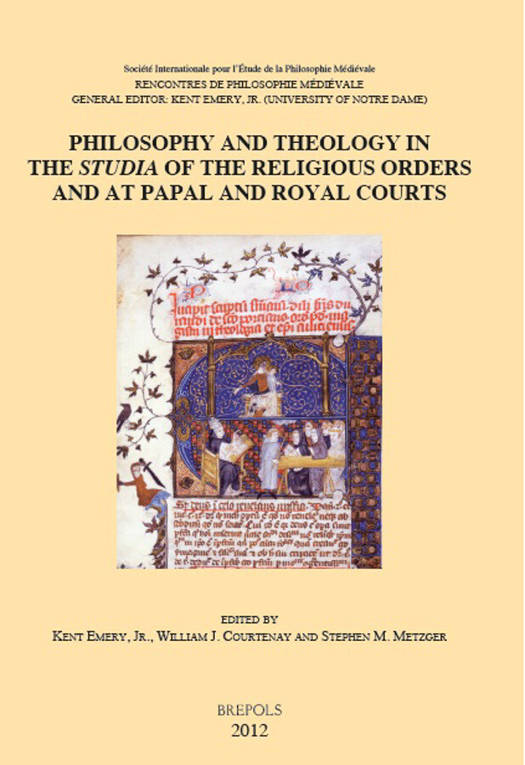
Philosophy and Theology in the 'Studia' of the Religious Orders and at Papal and Royal Courts
Acts of the Xvth Annual Colloquium of the Societe Internationale Pour l'Etude de la Philosophie Medievale, University of Notre Dame, 8-10 October 2008
Emery
90,10 €
+ 180 points
Description
Most scholars know that the great universities were the institutional setting of Scholastic philosophical and theological activity in the later Middle Ages. Fewer realize, however, that perhaps far more Scholastic learning in the liberal arts and theology took place in the studia, or study-houses of the religious orders, which out-numbered the universities and were more widely distributed across Europe. Indeed, most members of the mendicant orders received most or all of their learning in the liberal arts and theology in the studia of their order, and the most famous members of the orders (e.g., Albert the Great, Thomas Aquinas and John Duns Scotus) spent more time teaching in the studia than they did serving as Regent Masters in the university proper. As a consequence, the greater part of later medieval Scholastic literature was produced in the institutional context of the studia of the religious orders. Moreover, there were other significant institutional studia for Scholastic learning and discourse in the later Middle Ages besides the universities and the study-houses, namely the Papal Court-notably the Sacred Palace at Avignon-and several royal courts, for example, the courts of Robert the Wise in Naples and of the Emperor Lewis IV in Munich. It is not surprising, therefore, that many of the greatest Scholastic masters at different times taught in, or were associated with, all of these venues. This volume, which originated at the XVth annual Colloquium of the Societe Internationale pour l'Etude de la Philosophie Medievale held at the University of Notre Dame (USA) in October 2008, contains essays concerning the study and teaching of philosophy and theology in the studia of the Dominicans, Franciscans, Augustinian Hermits, Carmelites, Benedictines and Cistercians, as well as the intellectual activity at the Papal Court in Rome and Avignon and at various royal courts (London, Naples, Munich).
Spécifications
Parties prenantes
- Auteur(s) :
- Editeur:
Contenu
- Nombre de pages :
- 764
- Langue:
- Anglais
- Collection :
- Tome:
- n° 15
Caractéristiques
- EAN:
- 9782503543260
- Date de parution :
- 26-01-12
- Format:
- Livre broché
- Format numérique:
- Trade paperback (VS)
- Dimensions :
- 170 mm x 239 mm
- Poids :
- 1564 g


Seulement chez Librairie Club
+ 180 points sur votre carte client de Librairie Club
Cadeau

Cadeau


Les avis
Nous publions uniquement les avis qui respectent les conditions requises. Consultez nos conditions pour les avis.