


- Retrait en 2 heures
- Assortiment impressionnant
- Paiement sécurisé
- Toujours un magasin près de chez vous
- Retrait en 2 heures
- Assortiment impressionnant
- Paiement sécurisé
- Toujours un magasin près de chez vous



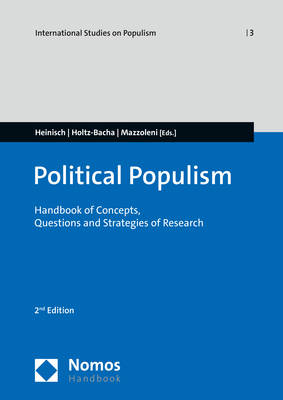
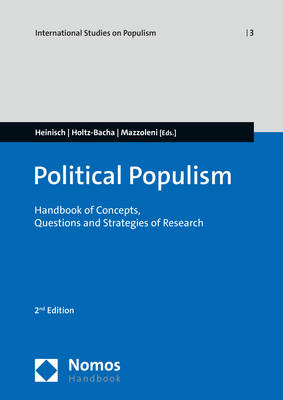
Political Populism
Handbook of Concepts, Questions and Strategies of Research
100,45 €
+ 200 points
Description
Populism represents the greatest political challenge to Western democracies since World War II. The electoral successes of populist parties and actors, Brexit, the presidency of Donald Trump or campaigns against containing the coronavirus pandemic are expressions of this phenomenon, in which the electorate is mobilised against supposed elites. The revised and expanded handbook Political Populism offers a comprehensive theoretical and empirical introduction to the causes and effects of political populism, especially in the democratic systems of Europe, but also in North and South America. It focuses on explaining populism as a consequence of a legitimation crisis of the representative system as well as on the controversies and limitations in the current academic debate. Drawing on political and communication science, the book also offers a comprehensive analysis of the effects of populism on various policy areas, such as environmental, health and economic policy.With contributions byTjitske Akkerman, Manuel Anselmi, Wolfgang Aschauer, Hans-Georg Betz, Cecilia Biancalana, Paul Blokker, Giuliano Bobba, María Esperanza Casullo, Carlos de la Torre, Paula Diehl, Sarah C. Dingler, Martin Dolezal, Marco Fölsch, Flavia Freidenberg, Sergiu Gherghina, Fabian Habersack, Vlastimil Havlík, Kirk A. Hawkins, Reinhard Heinisch, Christina Holtz-Bacha, Robert A. Huber, Gilles Ivaldi, Philip Kitzberger, Benjamin Krämer, Maria Elisabetta Lanzone, Zoe Lefkofridi, Dietmar Loch, Miroslav Mares, Alfio Mastropaolo, Oscar Mazzoleni, Sergiu Miscoiu, Teun Pauwels, Franca Roncarolo, Saskia Pauline Ruth, Carlo Ruzza, Steven Saxonberg, Christian H. Schimpf, Damir Skenderovic, Sorina Soare, Lone Sorensen, Carlos H. Waisman, Carsten Wegscheider and Sandra Vergari.With a welcome expansion in cases and policy fields, the second edition of Political Populism: Handbook on Concepts, Questions and Strategies for Research brings together scholars from a range of disciplines to reflect on the fundamental challenge populism poses today. This Handbook is essential to every reader who wants to understand where populism comes from, how it manifests and how it influences policies, political actors and the very institutions that make democracy. Theoretically sophisticated, substantiated in its content yet approachable for the interest reader, this Handbook marks an important step in the appreciation of the complexity and consequences of this global phenomenon. Annika Werner, Australian National UniversityTwo decades of turbulent political history show that populism is here to stay, and to shape politics for a long time to come. It is considered a serious threat to traditional democratic institutions. That's why political and communication scientists have massively engaged in studying it, in explaining it, in analyzing its features and implications. Among the several recent scholarly productions, this Handbook is perhaps the best tool put in the hands of all those who want to get a multi-dimensional yet comprehensive understanding of political populism as it is developing in Europe and in the Americas. Definitely a must-have book!Gianpietro Mazzoleni, Università di Milano, ItalyThis highly readable and detailed Handbook synthetizes a wealth of accumulated and innovative research on contemporary populism in Europe and the Americas. Drawing the insights of a distinguished group of specialists, the volume presents a comprehensive and updated view of the vibrant field of populist studies. Its four sections and thirty-four chapters provide stimulating perspectives on the theory, politics, and communicational dimensions of populism as well on emerging areas of research. A must read for anyone interested in understanding the complexities of a phenomenon that is likely to remain an enduring and unsettling presence in the political life of XXI century democracies. Enrique Peruzzotti, Universidad Torcuato Di Tella, Argentina
Spécifications
Parties prenantes
- Editeur:
Contenu
- Nombre de pages :
- 595
- Langue:
- Anglais
- Collection :
- Tome:
- n° 3
Caractéristiques
- EAN:
- 9783848766178
- Format:
- Livre broché
- Dimensions :
- 175 mm x 32 mm
- Poids :
- 989 g

Seulement chez Librairie Club
+ 200 points sur votre carte client de Librairie Club
Cadeau


Les avis
Nous publions uniquement les avis qui respectent les conditions requises. Consultez nos conditions pour les avis.