


- Retrait en 2 heures
- Assortiment impressionnant
- Paiement sécurisé
- Toujours un magasin près de chez vous
- Retrait en 2 heures
- Assortiment impressionnant
- Paiement sécurisé
- Toujours un magasin près de chez vous



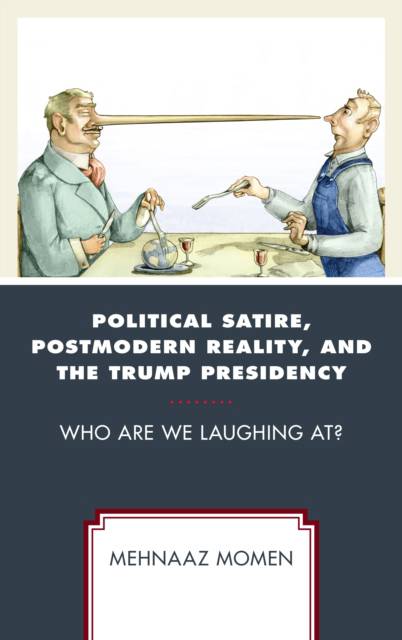
Political Satire, Postmodern Reality, and the Trump Presidency
Who Are We Laughing At?
Mehnaaz Momen
84,95 €
+ 169 points
Description
This book attempts to grasp the recent paradigm shift in American politics through the lens of satire. It connects changes in the political and cultural landscape to corresponding shifts in the structure and organization of the media, in order to shed light on the evolution of political satire on late-night television. Satire is situated in its historical background to comprehend its movement away from the fringes of discourse to the very center of politics and the media. Beginning in the 1990s, certain trends such as technological advances, media consolidation, and the globalization of communications reinforced each other, paving the way for satire to claim a prized spot in the visual media--a tendency that only gained strength after September 11. While the Bush presidency presented itself as an apposite target for satirists, their stronghold on American television was made possible by a number of transitions in broader culture, which are encapsulated in the shrinking space available for political engagement under neoliberalism. This largely underestimated development can be understood through the framework of postmodernism, which focuses on the relationship between language, power, and the presentation of reality. These trends and transitions reached a climax in the 2016 election where President Trump was elected, embodying what can only be considered a significant turning point in American politics. The bigger narrative contains various subplots represented in the rise of the neoliberal economy, the acceptance of postmodernism as the dominant cultural code, and the role of the voyeur superseding that of the engaged citizen. It is only through understanding each of these pieces and connecting them that we can comprehend the current political transformation. The present moment may feel like a golden age of satire, and it may well be, but this book addresses the hardest questions about the realities behind such a claim: what can we conclude about when and how satire is effective, judging by the history of this genre in its various incarnations, and how can the "apolitical" postmodern media landscape be reconciled with what the best of this genre has had to offer during times of political duress?
Spécifications
Parties prenantes
- Auteur(s) :
- Editeur:
Contenu
- Nombre de pages :
- 358
- Langue:
- Anglais
- Collection :
Caractéristiques
- EAN:
- 9781498562591
- Date de parution :
- 02-07-21
- Format:
- Livre broché
- Format numérique:
- Trade paperback (VS)
- Dimensions :
- 152 mm x 229 mm
- Poids :
- 485 g


Seulement chez Librairie Club
+ 169 points sur votre carte client de Librairie Club
Cadeau


Les avis
Nous publions uniquement les avis qui respectent les conditions requises. Consultez nos conditions pour les avis.