


- Retrait en 2 heures
- Assortiment impressionnant
- Paiement sécurisé
- Toujours un magasin près de chez vous
- Retrait en 2 heures
- Assortiment impressionnant
- Paiement sécurisé
- Toujours un magasin près de chez vous



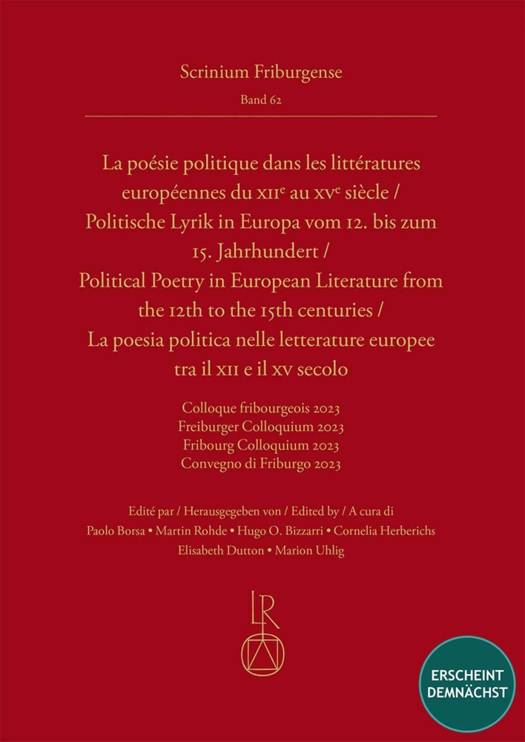
Politische Lyrik in Europa vom 12. bis zum 15. Jahrhundert
Freiburger Colloquium 2023
93,95 €
+ 187 points
Description
This volume contains the proceedings of the international conference held in Fribourg (Switzerland) in 2023, which addressed the emergence of a European tradition of political poetry between the twelfth and fifteenth centuries. Its chronological scope extends from the so-called twelfth-century renaissance to the fall of Constantinople, while its geographical horizon ranges from Iceland to the Caucasus, within a deliberately comparative framework. Political poetry is here understood as poetic production in which historical contingency and specific circumstances shape both form and meaning. Such texts are typically occasional and event-bound, engaging directly with political contexts and fulfilling pragmatic functions such as exhortation, persuasion, celebration, denunciation, or invective.
The volume adopts a multilingual and comparative perspective. Contributions are written in French, German, English, and Italian, in accordance with the quadrilingual design of the project. This linguistic plurality is methodologically significant insofar as it enables the study of political poetry across distinct literary traditions without reducing them to a unified interpretive model.
The essays collected here address a range of interrelated questions, including the relationship between poetry and historical events, the political potential of language ("politicity") beyond explicit thematic reference, and the articulation of power, community, and critique through allegorical and formal strategies. Particular attention is also devoted to the circulation and transformation of motifs and poetic techniques across linguistic and cultural boundaries.
By bringing together specialists in medieval European literatures, the volume reconsiders political poetry as a transregional and translinguistic phenomenon embedded in historical contingency. It offers analytical tools for the study of lyric production in relation to political discourse, with special emphasis on the interaction between occasional composition and broader ideological frameworks in medieval Europe. In doing so, the collection contributes to a reassessment of medieval lyric beyond the boundaries of national philologies and discrete literary traditions. It shows how poetic forms operated as instruments of intervention within public and political spheres, while simultaneously participating in the construction of symbolic languages of authority, legitimacy, and conflict. The volume thus provides a framework for further research on political expression in medieval European literature.
The volume adopts a multilingual and comparative perspective. Contributions are written in French, German, English, and Italian, in accordance with the quadrilingual design of the project. This linguistic plurality is methodologically significant insofar as it enables the study of political poetry across distinct literary traditions without reducing them to a unified interpretive model.
The essays collected here address a range of interrelated questions, including the relationship between poetry and historical events, the political potential of language ("politicity") beyond explicit thematic reference, and the articulation of power, community, and critique through allegorical and formal strategies. Particular attention is also devoted to the circulation and transformation of motifs and poetic techniques across linguistic and cultural boundaries.
By bringing together specialists in medieval European literatures, the volume reconsiders political poetry as a transregional and translinguistic phenomenon embedded in historical contingency. It offers analytical tools for the study of lyric production in relation to political discourse, with special emphasis on the interaction between occasional composition and broader ideological frameworks in medieval Europe. In doing so, the collection contributes to a reassessment of medieval lyric beyond the boundaries of national philologies and discrete literary traditions. It shows how poetic forms operated as instruments of intervention within public and political spheres, while simultaneously participating in the construction of symbolic languages of authority, legitimacy, and conflict. The volume thus provides a framework for further research on political expression in medieval European literature.
Spécifications
Parties prenantes
- Editeur:
Contenu
- Langue:
- Allemand
- Collection :
Caractéristiques
- EAN:
- 9783752008524
- Date de parution :
- 06-05-26
- Format:
- Livre relié
- Dimensions :
- 175 mm x 25 mm
- Poids :
- 616 g

Seulement chez Librairie Club
+ 187 points sur votre carte client de Librairie Club
Cadeau


Les avis
Nous publions uniquement les avis qui respectent les conditions requises. Consultez nos conditions pour les avis.