


- Retrait en 2 heures
- Assortiment impressionnant
- Paiement sécurisé
- Toujours un magasin près de chez vous
- Retrait gratuit dans votre magasin Club
- 7.000.0000 titres dans notre catalogue
- Payer en toute sécurité
- Toujours un magasin près de chez vous



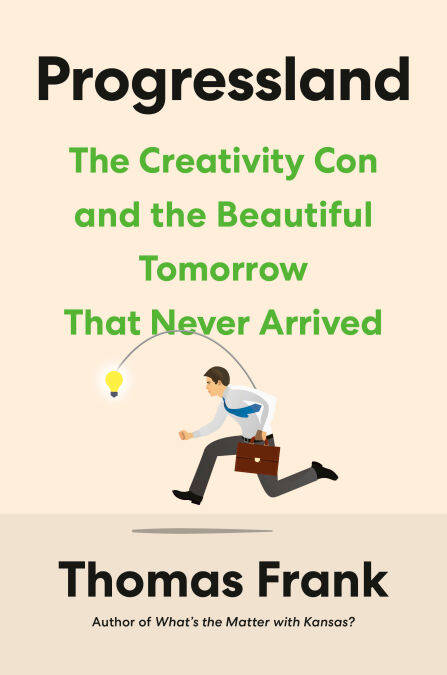
Progressland EBOOK
The Creativity Con and the Beautiful Tomorrow That Never Arrived
Thomas Frank
Ebook | Anglais
18,42 €
+ 18 points
Format
Description
From the best-selling and always-prescient author of What’s the Matter with Kansas? and Listen, Liberal comes a bold indictment of America’s chronic obsession with creativity and innovation, showing how these beloved ideas came to dominate our political and economic conversation, all while serving to mask inequality and protect elite interests
Innovation and creativity have been the defining watchwords of American exceptionalism for decades, used by business thinkers, tech gurus, military strategists, educators and urban planners to describe our unique standing in the world. While other countries supposedly suffer from regimentation and a fatal lack of imagination, the United States is often portrayed as an unmatched dynamo of new ideas and products. In his new book, Thomas Frank disabuses us of this notion, offering a bold account of the way creativity and innovation have been used as a kind of ideological cover for policies that reinforce the class system.
Frank charts the construction of America’s glamorous self-image from Sputnik to Silicon Valley, Apple to Lockheed Martin, Madison Avenue to Main Street, Richard Florida to Donald Trump. He deconstructs the innovation agendas touted by politicians; reads the books of pop psychology; tours SXSW, the mecca of creativity where musicians mingle with Pentagon officials; and looks in on the cafes, sidewalk murals, and bike lanes that populate the neighborhoods built for the creative class. Along the way, Frank uncovers the insidious effects of centering innovation and creativity in our rhetoric while, in practice, nurturing exactly the opposite. In the name of these noble goals, he shows, our leaders have reoriented the American economy around white-collar knowledge work, cut taxes on the wealthy, deregulated banks, off-shored manufacturing, reoriented cities, and destroyed what is truly creative about this country.
Deeply original, marked by Frank’s signature brilliance and acerbic wit, Progressland is a troubling X-ray of postwar American business and political culture — and a crushing indictment of the clichés that have undergirded its many failures.
Innovation and creativity have been the defining watchwords of American exceptionalism for decades, used by business thinkers, tech gurus, military strategists, educators and urban planners to describe our unique standing in the world. While other countries supposedly suffer from regimentation and a fatal lack of imagination, the United States is often portrayed as an unmatched dynamo of new ideas and products. In his new book, Thomas Frank disabuses us of this notion, offering a bold account of the way creativity and innovation have been used as a kind of ideological cover for policies that reinforce the class system.
Frank charts the construction of America’s glamorous self-image from Sputnik to Silicon Valley, Apple to Lockheed Martin, Madison Avenue to Main Street, Richard Florida to Donald Trump. He deconstructs the innovation agendas touted by politicians; reads the books of pop psychology; tours SXSW, the mecca of creativity where musicians mingle with Pentagon officials; and looks in on the cafes, sidewalk murals, and bike lanes that populate the neighborhoods built for the creative class. Along the way, Frank uncovers the insidious effects of centering innovation and creativity in our rhetoric while, in practice, nurturing exactly the opposite. In the name of these noble goals, he shows, our leaders have reoriented the American economy around white-collar knowledge work, cut taxes on the wealthy, deregulated banks, off-shored manufacturing, reoriented cities, and destroyed what is truly creative about this country.
Deeply original, marked by Frank’s signature brilliance and acerbic wit, Progressland is a troubling X-ray of postwar American business and political culture — and a crushing indictment of the clichés that have undergirded its many failures.
Spécifications
Parties prenantes
- Auteur(s) :
- Editeur:
Contenu
- Nombre de pages :
- 368
- Langue:
- Anglais
Caractéristiques
- EAN:
- 9780593657546
- Date de parution :
- 19-10-26
- Format:
- Ebook
- Protection digitale:
- Adobe DRM
- Format numérique:
- ePub


Seulement chez Librairie Club
+ 18 points sur votre carte client de Librairie Club
Cadeau

Cadeau


Les avis
Nous publions uniquement les avis qui respectent les conditions requises. Consultez nos conditions pour les avis.