


- Retrait en 2 heures
- Assortiment impressionnant
- Paiement sécurisé
- Toujours un magasin près de chez vous
- Retrait en 2 heures
- Assortiment impressionnant
- Paiement sécurisé
- Toujours un magasin près de chez vous



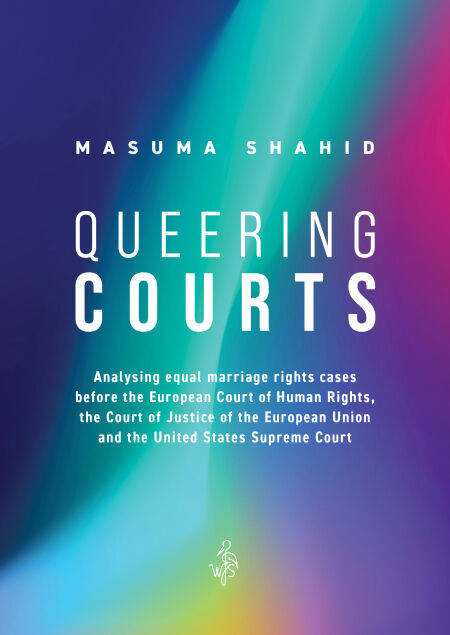
Queering Courts EBOOK
Analysing equal marriage rights cases before the European Court of Human Rights, the Court of Justice of the European Union and the United States Supreme Court
Masuma Shahid
Ebook | Anglais
59,00 €
+ 59 points
Description
Almost forty countries around the world currently allow same-sex couples to marry. While most of these decisions were made through legislative action, petitioners have increasingly also turned to courts to obtain marriage equality or 'equal marriage rights', i.e. the numerous rights and benefits connected to marriage and/or the legal
recognition of same-sex relationships.
With the use of queer legal theory, the research in this book analyses how courts such as the European Court of Human Rights, the Court of Justice of the European Union, and the United States Supreme Court interpret and apply the notions of 'sex', 'gender', 'sexuality' and 'sexual orientation' in their equal marriage rights case law.
The research reveals that courts interpret the notions as binary constructs and the dominance in the hierarchies therein is commonly anchored on certain heteronormative beliefs. This results in the discrimination, non-inclusivity and 'othering' of all that do not fall within the dominant part of the hierarchies, making them thus ineligible to enjoy 'full' or 'equal' marriage rights. While the decision-making of the courts is influenced by factors such as history, culture, religion, politics, etc., judicial self-restraint is oftentimes exercised for credibility, legitimacy, and authority reasons.
The research suggests that courts 'queer' their approaches, for instance by considering the notions more as spectra instead of fixed binary constructs, focusing more on the 'dignity' of the petitioners involved, applying the Yogyakarta Principles, creating an 'equal level playing field' and focusing less on applying heteronormative tools and methods, such as looking for 'consensus'. Queering the approaches of the courts might lead to more inclusive, diverse and universal adjudication. Until then, the enjoyment of full equal marriage rights is only for the heterosexually privileged.
recognition of same-sex relationships.
With the use of queer legal theory, the research in this book analyses how courts such as the European Court of Human Rights, the Court of Justice of the European Union, and the United States Supreme Court interpret and apply the notions of 'sex', 'gender', 'sexuality' and 'sexual orientation' in their equal marriage rights case law.
The research reveals that courts interpret the notions as binary constructs and the dominance in the hierarchies therein is commonly anchored on certain heteronormative beliefs. This results in the discrimination, non-inclusivity and 'othering' of all that do not fall within the dominant part of the hierarchies, making them thus ineligible to enjoy 'full' or 'equal' marriage rights. While the decision-making of the courts is influenced by factors such as history, culture, religion, politics, etc., judicial self-restraint is oftentimes exercised for credibility, legitimacy, and authority reasons.
The research suggests that courts 'queer' their approaches, for instance by considering the notions more as spectra instead of fixed binary constructs, focusing more on the 'dignity' of the petitioners involved, applying the Yogyakarta Principles, creating an 'equal level playing field' and focusing less on applying heteronormative tools and methods, such as looking for 'consensus'. Queering the approaches of the courts might lead to more inclusive, diverse and universal adjudication. Until then, the enjoyment of full equal marriage rights is only for the heterosexually privileged.
Spécifications
Parties prenantes
- Auteur(s) :
- Editeur:
Contenu
- Nombre de pages :
- 204
- Langue:
- Anglais
Caractéristiques
- EAN:
- 9789493458314
- Date de parution :
- 12-02-26
- Format:
- Ebook
- Protection digitale:
- Digital watermarking
- Format numérique:


Seulement chez Librairie Club
+ 59 points sur votre carte client de Librairie Club
Cadeau


Les avis
Nous publions uniquement les avis qui respectent les conditions requises. Consultez nos conditions pour les avis.